
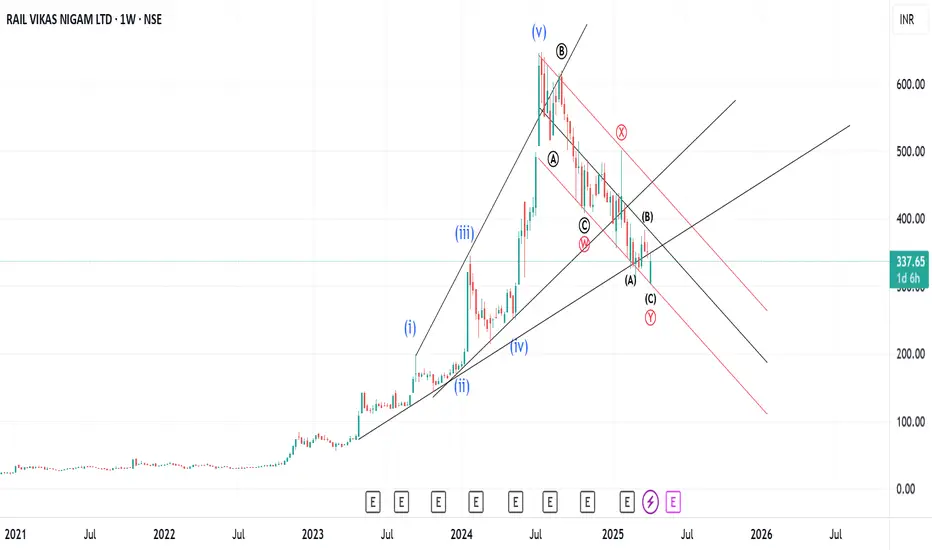
The only possible internal relationship between wave (i) and wave (iii) , when when wave (v) extends is w(iii) = 1.618 w (i) , which is the case here . If internal relationship is there then
w(v) = 1.618 w(0) - w(iii) measured from the end of w(iv) , ie internal count and this is the case here .
Next question is where this impulse is the end of a larger w(3) or end of a larger w(5) .I am assuming this is the end of a larger w(3) since w(v) overshoots trendline drawn from the end of w(i) and wave (iii) , that means the extended w(v) is the steepest .
Depth of corrective waves - When an extended 5th corrects it gives 99% retracement and ends at previous w(iv) of one lesser degree . Normally w-x-y (double correction is common) and w-x-y-x-z (triple correction is rare) . Had a wave 5 of a higher degree was been corrected the correction would have taken lesser time that it took to form w(v) . In this case time taken is more , hence the assumption that it correcting a higher degree w(3) . It means the correction is over .
w(v) = 1.618 w(0) - w(iii) measured from the end of w(iv) , ie internal count and this is the case here .
Next question is where this impulse is the end of a larger w(3) or end of a larger w(5) .I am assuming this is the end of a larger w(3) since w(v) overshoots trendline drawn from the end of w(i) and wave (iii) , that means the extended w(v) is the steepest .
Depth of corrective waves - When an extended 5th corrects it gives 99% retracement and ends at previous w(iv) of one lesser degree . Normally w-x-y (double correction is common) and w-x-y-x-z (triple correction is rare) . Had a wave 5 of a higher degree was been corrected the correction would have taken lesser time that it took to form w(v) . In this case time taken is more , hence the assumption that it correcting a higher degree w(3) . It means the correction is over .

免责声明
这些信息和出版物并非旨在提供,也不构成TradingView提供或认可的任何形式的财务、投资、交易或其他类型的建议或推荐。请阅读使用条款了解更多信息。
免责声明
这些信息和出版物并非旨在提供,也不构成TradingView提供或认可的任何形式的财务、投资、交易或其他类型的建议或推荐。请阅读使用条款了解更多信息。