包含IO脚本
Heikin-Ashi: The Structural Trade-Off Behind Smooth TrendsIn the charting community, Heikin-Ashi has long been a debated tool.
Many traders experience the same reaction the first time they switch to a Heikin-Ashi chart:
trends look cleaner, colors appear more consistent, and market noise seems reduced.
The chart feels more “logical.”
But an important question follows:
Is that smoothness coming from the market itself — or from mathematical processing?
Understanding this distinction is more important than simply asking whether the tool is “good” or “bad.”
1. What Does Heikin-Ashi Actually Do?
A standard candlestick chart displays raw price data:
Open, High, Low, Close.
Heikin-Ashi does not plot these values directly.
Instead, it recalculates them.
Its core formulas are:
1) Close (HA Close)
HA Close = (Open + High + Low + Close) / 4
The displayed close is the average of the four real prices.
2) Open (HA Open)
HA Open = (Previous HA Open + Previous HA Close) / 2
Each new candle inherits information from the previous one.
3) High (HA High)
HA High = max(High, HA Open, HA Close)
4) Low (HA Low)
HA Low = min(Low, HA Open, HA Close)
From these formulas, we can see that Heikin-Ashi is fundamentally a smoothing mechanism.
By introducing averaging and previous values, it reduces the visual intensity of short-term fluctuations.
That is precisely why it appears more stable.
2. Why Does It Work Well in Trending Markets?
In strong directional markets, price already exhibits persistence.
Smoothing in this context can:
Reduce frequent color flips
Make trend legs appear clearer
Extend sequences of same-colored candles
For swing traders or trend-following systems, this can help reduce noise and emotional overreaction.
In such environments, Heikin-Ashi can serve as a useful visual filter.
3. What Is the Trade-Off?
Every smoothing method comes with a cost.
1️⃣ The Price Is Not the Executable Price
Heikin-Ashi values are calculated — not traded.
When a color change occurs, the signal is based on computed prices rather than actual transaction prices.
During volatile periods, the gap between HA values and real market prices can widen.
For traders who rely on precise entries, this distinction matters.
2️⃣ Lag Is Structurally Built-In
Because each candle incorporates data from the previous one, lag is unavoidable.
In fast reversals, the real market may have already moved significantly before the HA candle changes color.
In steady trends, this lag is less noticeable.
In choppy or rapidly shifting markets, it can reduce responsiveness.
3️⃣ Certain Price Behaviors Are Softened
Gaps, extreme wicks, and sharp intrabar reversals may be partially smoothed out.
If your trading logic depends on detailed price behavior — such as wick rejection or gap momentum —
Heikin-Ashi may reduce the informational granularity you rely on.
4. Suitability Matters More Than Judgment
Heikin-Ashi is not a “wrong” tool.
The real issue is alignment.
If your strategy focuses on:
Capturing trend continuation
Holding positions longer
Reducing frequent entries and exits
Then Heikin-Ashi may serve as a helpful visual aid.
But if your edge depends on:
Capturing short-term volatility
Precise timing
Reading subtle structural shifts
Then applying a smoothing algorithm to your primary chart may conflict with your execution logic.
5. A Balanced Approach
Some traders choose to:
Use Heikin-Ashi to assess directional bias
Use standard candlesticks for entry and risk management
This separation of roles can provide clarity without sacrificing execution precision.
There is no “perfect” chart type.
Any tool that smooths price is making a trade-off between noise reduction and information detail.
The key question is not:
Is this tool good?
But rather:
Does it align with my trading logic?
In chart analysis, understanding how data is constructed is often more valuable than adding another indicator.
Heikin-Ashi:顺滑趋势背后的结构代价在图表社区里,Heikin-Ashi(平均足)一直是一个颇具争议的工具。
很多交易者第一次切换到平均足图表时,都会有一种非常直观的感受:
趋势变得干净了,颜色变得统一了,震荡似乎减少了。
图表看起来更“有逻辑”。
但问题在于——
这种“顺滑”,是来自市场本身,还是来自算法处理?
理解这一点,比单纯讨论它“好不好用”更重要。
一、Heikin-Ashi 做了什么?
普通K线记录的是原始价格:
开盘、最高、最低、收盘。
而 Heikin-Ashi 并不是直接展示这些价格,而是对它们进行了再计算。
它的核心公式如下:
1)收盘价(CloseHA)
CloseHA = (Open + High + Low + Close) / 4
也就是说,当前K线的“收盘价”是四个价格的平均值。
2)开盘价(OpenHA)
OpenHA = (前一根 OpenHA + 前一根 CloseHA) / 2
这一步让每一根K线都“继承”上一根K线的信息。
3)最高价(HighHA)
HighHA = max(High, OpenHA, CloseHA)
4)最低价(LowHA)
LowHA = min(Low, OpenHA, CloseHA)
从公式可以看到,Heikin-Ashi 本质上是一种平滑处理机制。
它通过引入“前值”与“平均值”,降低了短期波动的表现强度。
这正是它看起来更稳定的原因。
二、为什么它在趋势行情中表现良好?
在单边趋势中,价格本身就具有延续性。
此时平滑算法会:
减少反复变色
让趋势段更清晰
延长同色K线序列
对于中线或趋势跟随型策略来说,这种处理有助于减少干扰。
它在过滤噪音方面确实具备价值。
三、但它的代价是什么?
任何平滑处理,都会带来代价。
1️⃣ 报价并非真实成交价
Heikin-Ashi 的价格并不是市场真实成交价。
当图表出现“变色”时,触发信号所依据的价格是经过计算的逻辑价格,而不是实际撮合价格。
在波动剧烈时,这种偏差可能扩大。
对于依赖精确入场点的短线交易者而言,这一点尤为重要。
2️⃣ 滞后性不可避免
由于每一根K线都包含前一根的数据,它天然具备延迟特征。
当市场发生快速反转时,真实价格可能已经走出较大波动,而平均足的颜色变化仍然滞后。
在趋势行情中,这种延迟问题不明显。
但在震荡或快速切换环境中,它可能降低反应速度。
3️⃣ 部分价格行为被弱化
跳空缺口、极端影线、快速探底回拉等结构,在平均足图表中会被部分平滑处理。
这意味着:
如果你的交易逻辑依赖细节结构(例如影线强弱、缺口动能),
那么平均足可能会降低信息密度。
四、适配比“好坏”更重要
Heikin-Ashi 并不是“错误工具”。
问题不在工具本身,而在适配关系。
如果你的策略核心是:
捕捉趋势延续
延长持仓周期
减少频繁进出
那么它可能是有效辅助工具。
但如果你的逻辑是:
捕捉短线波动
依赖精确入场
利用细微结构变化
那么使用经过平滑处理的图表,可能会与策略逻辑产生冲突。
五、一个更稳妥的使用方式
有些交易者会:
同时打开原始K线与平均足
用平均足判断趋势方向
用原始K线执行入场与止损
这种“分工式使用”方式,比单一依赖更为稳健。
交易中不存在“完美图表”。
任何让图形变得更顺滑的算法,本质上都是在信息与噪音之间做取舍。
关键问题从来不是:
这个工具好不好?
而是:
它是否与我的交易逻辑匹配?
在图表分析中,理解数据来源,往往比寻找更多指标更重要。
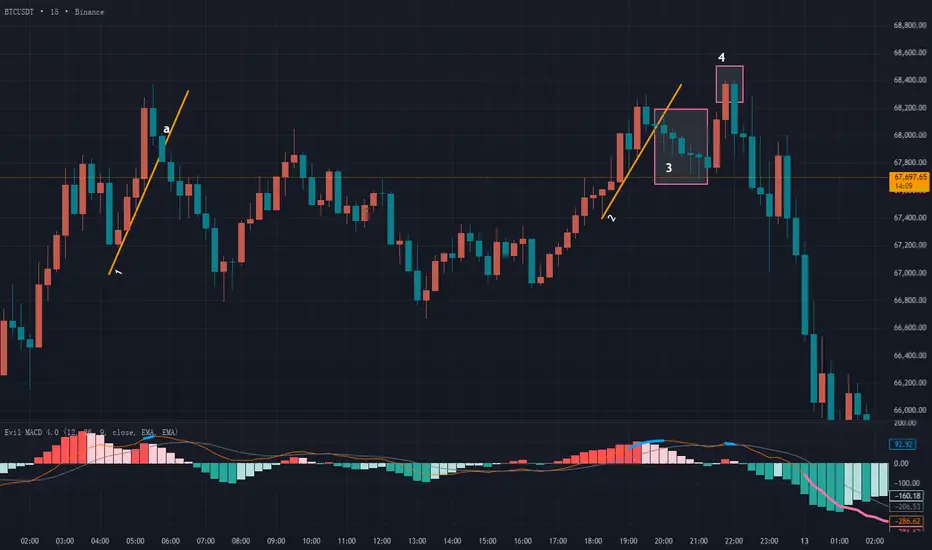
如何筛选高确定性的结构转化 # 26-2-15|BTC · ETH · 黄金1 BTC
今天的BTC没有出现很好的机会(注意这里的结论仅仅是对于15min图表的分析,可能在其他的周期里存在机会,我们用相同的思路去分析即可)。
首先我们看到那段形状很奇怪的下跌,也就是盘面上标1的位置,我说这里形状奇怪是因为那根突然的大阴线,随后又直接发生一个止跌,随后反弹,这里的行情很没有规律,也无法画出趋势线,但是就像前面说的一样,在当前周期没有趋势线,不代表更小的周期里也没有,所以这里的趋势线反转位置很可能在5min图表或者1min图表里。
同样,后来我们又看见了一段同样奇怪的下跌,盘面标记2的位置,这种情况和1非常相似,突然增大的阴线,突然展现强势的空方动能,但持续一根k线之后迅速恢复正常,当前周期里画不出趋势线,因此无法用趋势线进行分析,这里的趋势线反转结构,也很大概率藏在更小的周期里。
2 ETH
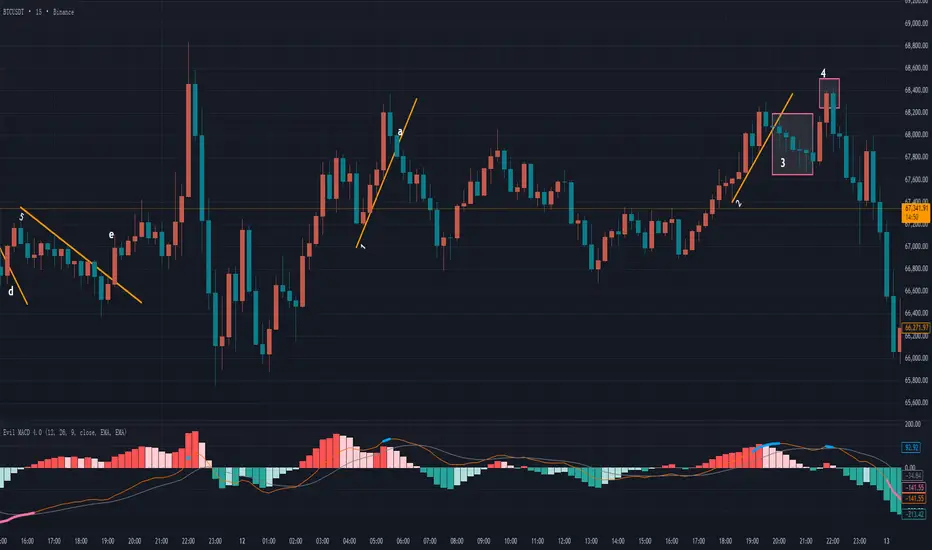
ETH大致和BTC走势很相似,但细节上有区别。
首先还是一个下跌趋势和底部粉色预警,由a点突破。注意a点的k线虽然有上影线,但仔细比较之后,发现上影线的长度低于整体的50%,因此属于能接受的范围,但如果要判断这里入场的话,就需要承受一个幅度偏大的止损空间,尽管这里后来给到了止盈机会,但我们在实盘当中无法预测之后的行情走势,潜在止损空间还是存在的。所以这种地方就要看自己的交易风格了,如果偏保守,可以选择放弃或者小仓小杠杆参与,如果偏激进,也可以选择参与。不论风格是哪种,风险意识永远放第一,考虑止盈之前一定要先考虑清楚潜在止损。
随后我们可以看见一段上涨的趋势2,同时看见了一段蓝色顶部信号,而且由b点向下突破,这里我们要注意b的形态,是一个小实体、小影线的形态,看不出很强的空方动能,b点之后,紧跟着一根十字星,那就说明这里并没有太强的空方动能体现出来,而是处于一个多空双方正在博弈的阶段。这个位置充满了不确定性,因此最好是放弃,这里的k线形态,确定性甚至低于a点。
今天的ETH确定性最高的结构转化在趋势线3这里,我们看见这里趋势线3尽管被一条阳线的最低价短时间突破了,但幅度很小,而且迅速收回趋势线之上,并没形成破坏,同时产生了蓝色顶部预警。随后趋势线3被向下突破,注意突破的阴线,实体为主,影线非常小,几乎可以忽略不计,和前面的a点b点对比,这里的结构转换确定性是最高的。
3 黄金
黄金的走势很有意思,我们可以重点对比一下1和2这两条线的特点,在趋势线1位置,行情一开始是小阴线为主,随后突然有一个增大的实体阴线,紧跟着又一根阳线迅速拉回,走出了一个V字型的反转形状,这里的大阴线就是一个很突兀的变化,属于突发的异常行情,充满不确定。再对比一下趋势线2,虽然阴线实体还是大,但我们发现这里的阴线实体都差不多,没有突然增大的情况,都按照趋势线有规律地发展,尽管后面向上突破的位置影线占主体,但这里带来的反转幅度比1还是更大,这就是我一直在找这种发展规律、不突兀趋势线的意义所在,因为这种走势干净的结构会给我们带来更大的确定性。1 和2 两个突破位置都是需要放弃的机会。
最后我们能看见一段振幅突然增大的区域3,这里是画不出趋势线的,因此无法用趋势线理论进行分析。
总结
通过今天的复盘我们能看出,不是所有的反转预警之后都能带来一个入场机会。我们通过对比具体的趋势线特点、k线动能分析,可以对比得出当前确定性最高的最佳位置。
另外,如果遇到突然增大的行情,很难确定反转结构确认的时候,更标准的模型很可能藏在周期更小的图表里,就类似于SMC分析当中的自同构性结构,比如当前周期里发生了一个BoS,我们去更小的周期中很可能找到一个更接近极值的BoS结构。
The Dangerous Candle: The Large Bullish ExpansionWe often see suddenly expanded candles in the market. Many traders fear missing out and rush to enter on these explosive moves.
However, these impulsive entries are often the ones that get stopped out the most.
Take today’s BTC as an example.
After a period of consolidation, price gradually formed a short-term downtrend. At the bottom, a small reversal warning appeared (marked by the pink line in the chart). If we observe carefully, we can draw a gently descending trendline (Trendline 1), which was broken upward at point A.
Let’s focus on candle A.
This is the type of explosive bullish candle many retail traders love to chase. The candle is almost entirely body, with barely any wicks. Its size exceeds all nearby candles — a sudden, exaggerated expansion.
Based on theory, you might conclude that bullish momentum here is extremely strong. And that’s true — momentum is strong.
But in my own trading, this is exactly the kind of setup I would avoid.
We need to understand one key concept:
Strong momentum does not necessarily mean sustainable momentum.
In markets like Gold, BTC, ETH, and forex, we often see sudden, unexpected volatility. Sometimes it’s not just noise — it becomes a strong one-sided move. These extreme moves create a psychological illusion that the strength will continue.
But that is not always the case.
When a candle suddenly expands, the movement is usually very fast. What appears to be a 15-minute bullish candle may have completed most of its body within just 1–3 minutes. During that rapid move, price changes so quickly that many opposing orders may not have had time to get filled before price has already moved away.
Not everyone places passive limit orders waiting to be matched. Some traders execute manually, some do not use conditional orders. When price moves too quickly, certain price areas may contain many unfilled or skipped orders.
This often leads to a new kind of market imbalance. Price may later revisit those thin-liquidity areas to rebalance orders — even if the broader trend continues afterward.
This is essentially the core logic behind FVG (Fair Value Gap).
In today’s BTC example, price at point A surged upward rapidly. There may have been unfilled sell orders left behind. The move could also have overextended bullish momentum, increasing the probability of a pullback.
Again:
Strong momentum does not guarantee continuation.
If price had pulled back and continued downward, point A would have become a false breakout. On a higher timeframe, A and the following candles might even form a pin bar with an upper wick.
In reality, what happened afterward was this:
Price pulled back sharply, almost returning to the low of candle A, but then bulls regained control and pushed price higher again.
That is what we see in hindsight.
But in live market conditions, we cannot precisely predict such outcomes. The “abrupt” nature of that large candle introduces greater uncertainty into the market.
The more abrupt the movement, the greater the uncertainty.
That is why I would avoid entering at point A. Even though the move looks attractive, discipline and rational thinking are more important. Large impulsive moves often hide traps.
Next, we observe a consolidation zone (Area 2). There was a blue top warning signal, but no valid upward trendline could be drawn. Therefore, trendline theory could not be applied here. (Every method has situations where it does not work — that is normal.)
Later, we see Trendline 3, a clear upward structure. After a small bearish candle near the top, it was followed by a larger bearish candle breaking below Trendline 3.
This marks a structural shift from bullish to bearish.
Entering at this structural break, compared to point A:
Lower probability of extreme reversal
Smaller stop-loss distance
Higher probability of price moving in the expected direction
From the outcome, we can see that entering at the break of Trendline 3 provided at least as much profit potential as chasing at point A — in fact, even more.
If you had entered at A:
Larger stop-loss
Higher uncertainty
Questionable sustainability of bullish strength
Constant risk of reversal
So don’t get overly excited when you see a large move.
Stay rational.
Big moves are often traps.
On the other hand, the seemingly less dramatic structural shifts — those confirmed by logic and market validation — often provide clearer direction, more stable trades, and sometimes even unexpected rewards.
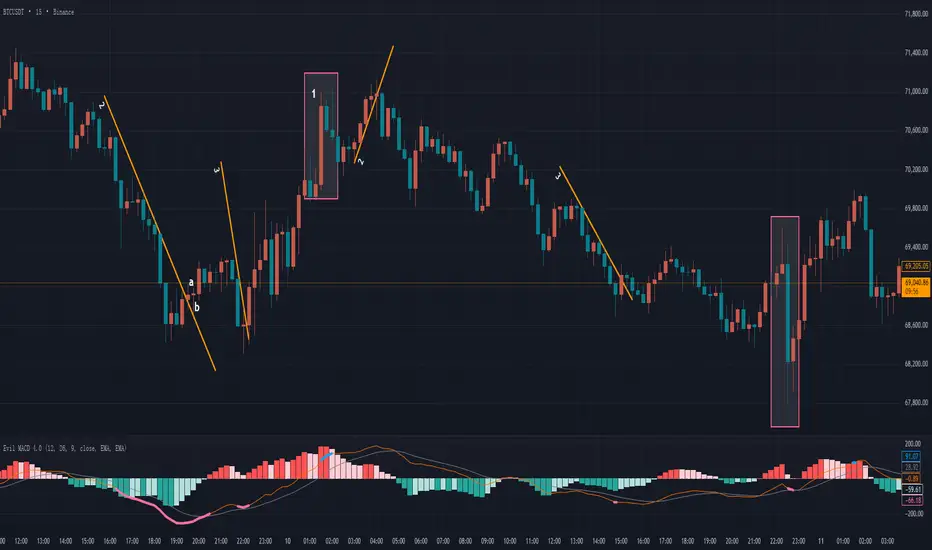
最危险的,是那根大阳线 # 26-2-15|BTC我们经常在市场中看见一些突然增大的k线,很多人害怕错过机会,喜欢追着下单,但是这种追着下单的时候,往往是造成止损最多的订单。
就比如今天的BTC
我们能看出来,经过了一段横盘之后,逐渐走出一段下跌趋势,底部形成一小段反转预警(图中粉色线标记位置),仔细观察会发现一条平缓下降的趋势线1,在a点向上突破。
我们重点讨论一下a这根k线,这是很多散户都喜欢追的一种暴涨形态。a一根k线几乎全是实体,几乎没有影线,这个实体超过了附近所有的阴线阳线大小,突然放大的、夸张的大阳线。
也许你根据之前讲过的理论,会认为这里表示多方的动能非常强劲,不错!多方动能很强,但这个位置我自己在交易中一定会放弃!我们要搞清楚一个概念:动能的强,不代表动能有持续性。
在黄金、BTC、ETH还有一些外汇市场中,经常会遇到一些突发的、没有征兆的波动行情,而且这种行情可能不是震荡,而是某个单向的强势行情。这种极端的走势会让我们从内心产生一种错觉:好像这种强势会持续。但实际上不一定,因为当一根k线突然放大的时候,一般来说是运动非常迅速的,有时候看起来15min的大阳线,很可能在1-3分钟之内就走完了k线大部分的实体区域,在这些区域当中,价格变化非常快,很可能有对手方的订单还没来得及成交,价格已经过去了。
因为不是所有人都会挂被动订单去等着对手主动匹配,市场中总有人手动下单,总有人没有设置自动条件单,当行情迅速变化的时候,这些区域会出现很多潜在订单,没来得及成交就已经错过了。这种时候,往往会形成新的某种市场合力,行情会有一种动能去填补这些订单稀少的区域,即便是会继续这里的单向行情。
注意,这就是FVG的核心原理,那我们再看到今天BTC的这个例子中,a迅速向上移动,中间就有可能存在没来得及卖出的潜在空单,这里价格移动过快,也有可能过度透支了多方动能,之后有可能会产生回调。
这就是我前面说的:动能的强,不代表动能有持续性。如果这里回调了而且继续向下,那a点就是一个假突破,而且在更高周期图里,a点和之后的k线会组成一个影线朝上的pinbar形态。但我们在盘面上看见的结果,是a点之后行情迅速回调,曾经被打压到了非常接近a点最低价的位置,但之后多头再次发力,把行情继续推上去。这是事后看见的结果,但如果处在当时的盘面中,我们并不能精确预测这种走势,而当时的盘面由于大阳线带来的“突兀”感,会让市场充满更多的不确定。
因此越是这种突兀的区域,不确定因素越大,所以这是我会放弃的入场点,尽管行情很诱人,我还是要保持冷静和理智,这种大行情,后面带来的很可能是一个陷阱。
随后我们可以看见一段横盘,也就是标记2的区域,我们注意到这里有顶部的蓝色预警线,但是画不出上涨的趋势线,因此无法用趋势线的理论进行分析。(每一种理论总会有失效的时候,这很正常)
之后我们看见了一段趋势线3,是一条明显的上涨趋势,在顶部经历一个小实体阴线之后,后面接了一个实体变大的阴线,向下突破了趋势线3,这里就是一个多转空的结构转换。选择在这里入场,和a点相比,碰上极端反转的概率更小,止损空间更小,行情向我们期望的方向发展的概率也更大。
我们从结果能看出来,选择在趋势线3的突破位置入场,带给我们的止盈空间,和a点相比并不会低,反而比a点更多。如果在a点判断入场,止损空间大,行情不确定性高,还不确定这里多头的持续性如何,随时有可能发生一个反转。
所以不要看见大行情来了就激动,随时保持理智的思维,大行情很可能是一个坑,反而那些不起眼的、经过逻辑推断和市场验证的结构转换,往往能带给我们更确定的方向,和更稳健的交易,而且后面很可能还有意外惊喜。
市场合力的形成:点火与跟风 # 26-2-14|BTC
首先我们可以看见一大段蓝色预警,代表潜在顶部,然后形成了一条趋势线1,而且这是一条经过验证的趋势线,由d点向下突破,但我们要注意这里突破k线本身,是一根接近十字星的形态,实体占比非常小,带有很长的下影线,而且d点之后马上反弹,这里是不能判断有效的多转空的。
之后的上涨形成了趋势线2,同样也经过了市场的验证,而且在e点向下突破,我们注意到e点是实体为主,影线可以忽略不计,这里可以判断出一个多转空的结构转换。
那今天最关键的问题就来了:如果这里空单入场,我们看不出止盈空间。这就涉及到今天要讲的重要概念:市场合力的点火与跟风。
市场上有很多交易员,有不同规模的散户,也有资金量非常大的机构、公司,资金规模大的这些机构也并不一定是受到某一个观点的统一影响,大家有可能存在不同的意见,所以我们能看出盘面上一版都处于一种无序的震荡行情当中,没有清晰的方向。
但是也会形成某一段突然的加速上涨或下跌,在小流通值的品种当中,这种某一个方向的行为的确有可能是某一个大型“操盘手”引起的,但如果是BTC、XAU或是外汇这种大流通值的品种呢?单个机构对于这么大市场的影响是可以忽略不计的,因此在这些大流通值的品种里,某一方向的行情可以理解为一种“市场合力”,也就是代表大多数交易员认可的方向,才会导致有一方的主动订单不断吃掉另一方的被动挂单,从而引起价格迅速向某一方移动。
反转的时候,也并不是直接来一个干脆的掉头,而是有一部分反向力量开始发力,做出一个“测试”,我们可以把这种行为理解成“点火”的动作,点完火之后,我们看一下这把火能不能烧起来,如果烧不起来,说明现在条件不佳,可以再等等。
大家在盘面上看见的一些假突破、插针、欺骗行为,很可能都是这里讨论的“点火”动作。为什么要存在点火?因为市值大的品种,如果要真的操盘,会付出极高的成本,因为需要大量的主动订单去吃掉被动挂单,还要对付在这个过程中新挂出来的被动订单,这个成本是很多机构都无法承担的。
这里的e点,我们就可以理解为一部分空方势力的“点火”动作,测试一下这里有没有到那个大家都认可的临界点。点火之后,市场会不会像链式反应一样一触即发,大家纷纷揭竿而起站队空方,形成一波流畅下跌,那我在这里的点火就成为了空方成本最低的一个点。
f的出现,代表了市场上多数人并不认可这种想法。f下影线很长,说明这里出现过一部分空方力量,曾经把价格推到了f的最低价位置,但是出现问题了,到了f最低点之后空方力量衰竭了,被反向的多方力量推到了收线价格位置,甚至形成了十字星的小阳线,这里说明“点火”之后没有人跟风了。
市场是永远充满未知的,随时有可能出现反转,用这种“点火”和“跟风”的方式去看待市场,我们就可以理解很多行为了。
这里如果在e点选择了空方入场点,那看见f之后也应该马上意识到点火之后出了问题,及时出场,这里产生的亏损并不大,非常接近成本线,这就是一种灵活的、科学的风险控制方法,这种分析思路也来自于《威科夫操盘法》这一经典理论,“点火”和“跟风”是我加入了一些自己对市场的理解和思考。
同样的事情发生在趋势线3之后,但趋势线3本身是没有经过市场验证的,所以这里的反转确定性本身是更低的。随后我们可以看见在g有一个实体阴线向下突破,但看这里的阴线,可以判断一个多转空信号,也就是发生了一部分空方力量的“点火”动作。
随后我们看见k这里直接一个阳线反包回去,而且仔细对比发现,k的实体超过了g,说明点火之后不仅没出现跟风的力量,反而被多方强势压制,这就说明这里的空方合力不够强大,现在很难形成有效的空方持续性,因此出现k之后,也应该警惕起来,及时止损,即便还没到止损线,在k点之后的几个小阴线,都看不出很强的空方动能,印证了前面的假设:空方缺乏力度。所以在这里最接近成本线的位置,应该判断止损小亏出局。
然后我们可以看见另一段趋势线4,而且在n点向下突破,这里也满足我们判断多转空的逻辑:蓝线预警信号、形成趋势线、趋势线被反向突破。显然,根据上面的描述,n点也属于一个空方的“点火”动作,但这里我们能明显看出之后有“跟风”,产生了更大的阴线,说明市场上有更多的交易员、机构接受了这里空方的“点火”动作,选择支持空方,于是这里形成了一波市场合力,方向是空方。
我在之前的分析里说过一句话:“我们要做的是在概率最大的位置选择跟随市场合力,但市场合力能带我们走多远,需要一点运气”。这句话的意思就是,我们可以从盘面的客观信息里看出这种“点火”动作,但点火之后是否存在“跟风”行为?我们是无法预测的,但一般在这种位置判断入场,会给到我们概率优势和盈亏比优势,因为一旦形成市场合力,会经历迅速的、大幅度的浮盈,就比如今天BTC的行情,判断的市场合力点有3个,前两个属于点火之后没有跟风,有一个是点火之后出现了空方的跟风行为,但这一个正确的入场点,止盈会盖住前面两个入场点带来的止损。
理解了这种点火与跟风的逻辑,还有市场合力的原理,你会发现对市场和行情的理解更深入,更接近本质。
结构量化与狙击式交易 # 26-2-13|BTC · ETH · 黄金1 BTC
今天刚开始就是一段流畅的下跌趋势,而且走势稍微复杂一些,我们仔细拆解了分析。
首先能画出一条趋势线1,注意这是一条刚形成的趋势线,没有经过市场验证,具体表现为a点之前的k线并没有验证到趋势线的位置,而是中间产生了一段空间距离。之后由a点向上突破,而且a点的实体为主,没有很长的上下影线,这里属于满足硬性条件,但质量欠佳的反转位置,趋势线没经过验证,a点突破并不算明显超出趋势线,比较接近,所以这里也取决于自己的风险偏好,激进型可以判断反转,稳健型也可以再等等。
在a点突破失败之后,产生了另一条趋势线2的走势,我们会发现2是经过了市场检验的,因此2的质量高于a,且由b点向上突破,仔细观察发现,b点虽然有上影线,但影线长度其实略低于实体,所以质量还算及格,风险能接受,这里可以判断一个结构反转。
经过短暂的上涨之后,再一次产生一段回调,并形成了趋势线3,我们注意到趋势线3同样经过了市场的验证,而且由c点向上突破,c是一条完全实体的阳线,没有影线,而且明显脱离了趋势线,和a、b两个点相比,c点是展现出多方动能最强的位置。
我们对比abc三个突破点的具体细节:
a - 趋势线未验证,实体占比70%,略微突破趋势线
b - 趋势线有验证,实体占比60%,略微突破趋势线
c - 趋势线有验证,实体占比100%,明显突破趋势线
这三个点当中哪一个最好,这样对比之下一目了然。有很多人在交易中不做这样的分析和对比,判断入场点经常是基于情绪和主观判断,但我们面对的是一个客观的市场,你的主观想法市场不一定认可,但市场中客观表现出来的现象,可以推导出某种导致现象产生的原因。
就比如这里通过对比三个突破点的客观条件,我们能得出哪一个突破是最佳的,这里的对比完全参考的是盘面告诉我们的客观事实,不带有任何主观因素,之后我们也可以从盘面上看出来,当我们真正用冷静、客观的视角去分析盘面之后,市场会给到我们多大的奖励。
2 ETH
ETH和BTC展现出了高度相似的特点,这是很常见的现象。
首先也是一段流畅的下跌,而且底部产生了粉色的底部预警,我们能清晰画出一条趋势线1,之后由a点向上突破,但我们要注意到a点本身是没有实体的,是一条标准的十字星k线,这种形态的k线说明此处是多空双方激烈博弈的位置,我们在看到a之后的k线b,b虽然有了实体,但实体占整体的比例大概是50%,不能算很强势的多头动能,所以这里我们仍然只能判断为多空双方的博弈区,不能判断反转的确认。
然后我们会发现形成了一条趋势线2,并且由c点向上突破,注意c点的突破更小,而且实体占比更小,那就说明这里多空还是处于博弈阶段,不能判断反转结构,然后我们看到d点,马上形成了一根十字星小阴线,这印证了前面的推断,多空双方仍在僵持,未分胜负。然后我们看见e点,是一个实体占到了70%-80%的实体阳线,明显向上突破脱离了底部的横盘区间,因此e点才是这里空转多的结构确认位置。
我们再用前面讲的方法来对比一下这里的几个点:
a - 趋势线有验证,实体占比0%,略微突破趋势线
b - 趋势线有验证,实体占比50%,略微突破趋势线
c - 趋势线有验证,实体占比30%,略微突破趋势线
d - 趋势线有验证,实体占比5%,略微突破趋势线
e - 趋势线有验证,实体占比70%,明显突破趋势线
同样,这里的条件都是盘面展现出来的客观数据,没有带入任何个人主观意见,其中趋势线是否验证,实体占比完全是可用数据量化的结果,突破趋势线的幅度虽然不便于测量,但能用肉眼对比出明显和略微的程度,也属于一种客观的数据结果。
我们也能看见,一旦判断了最佳的入场位置,市场能带给我们多大的奖励。
另外,在e点之后有一段回调段,盘面上标记f的区域,注意到这里虽然有回调,但我们仔细观察会发现,其中的阴线都逐步在减小,说明了这里的空方动能已经处于衰竭状态(注意,多空力量的衰竭是威科夫理论中的重要分析)。
3 黄金
今天的黄金就是很典型的“有行情,无机会”。
首先我们能看见一大段的底部预警,粉色粗线标出的位置,形成一条趋势线1,由a点突破,但我们注意到趋势线1是没经过市场确认的,而且加上之前的暴跌,这里判断反转的风险是非常大的!我们尽量不要在这种突然放大的波动之后去判断行情,很容易再次发生反转。
之后形成了趋势线2,而且由b点向上突破,虽然2是一条经过验证的趋势线,但b点也是一个十字星形态,没有展现出太强的多方动能,不仅如此,b点之后连续几条k线都是小实体的十字星形态,这里也最好是放弃。
最后有一段顶部预警,而且形成了趋势线3,但我们要注意到的是c这条线,明显突然增大的下影线,和1之前的波动很像,属于突发的震荡行情,只是幅度没有1那么大,同时我们看到3被突破的位置,同样是一根实体突然增大的夸张阴线,这种波动放大的区域,我们尽量放弃。
总结
我们自己的想法是主观的,市场是客观的。
趋势线是否被验证,是客观事实。
实体占比是多少,是客观数据。
突破幅度是否明显,是客观表现。
当我们用这些客观条件去做筛选,情绪自然会退出决策。
交易不是预测,而是筛选。不是抓住所有机会,而是只做质量最高的那一个。
市场每天都有行情,也存在很多机会和陷阱,我们的本金就好像子弹一样,如果每一个机会和陷阱都去判断入场,会浪费弹药,所以我们要做一个狙击手,大多数时间都在潜伏和等待机会,很少出击,但出手必杀敌,当你学会今天讲的这种筛选逻辑之后,交易就会变得更安静。
# 26-2-12 A Random Market Demands Fixed Rules1. BTC
First, we can see Trendline 1. At the top of this trendline, a blue alert line appeared. Later, the trendline was broken downward at point a, ending the uptrend here.
The key question is whether point a can be considered a multi-to-short structural reversal. There is no fixed answer. Objectively, it is indeed a breakout. Point a is a solid candle with almost no wick, and it does not land exactly on the trendline—it clearly exceeds it. However, we also notice a previous bullish candle that is more than twice the size of point a’s bearish candle, indicating that the downward momentum at a is not yet very strong.
Thus, there is no definitive answer. This structural reversal has both pros and cons, and it depends on your risk preference. Aggressive traders may consider this a confirmed multi-to-short reversal point, while conservative traders may choose to skip it. Remember: risk and reward are always proportional. You either choose steady conservatism or aggressive growth—you cannot have both.
Afterwards, the market entered a consolidation phase. When Trendline 2 was formed, a blue alert line appeared at the top. The trendline itself was fine, but the subsequent breakout raised concerns. The breakout candle had a wick more than twice the size of its body, a classic multi-vs-short battle candle. When seeing such a candle, caution is needed—this could be a trap! In region 3, multiple doji and long-wick candles appeared, showing that buyers and sellers were fighting intensely, with no clear winner. This is an area full of uncertainty, and it’s best to skip trading here.
Indeed, the market later reversed again, confirming the previous analysis. A new blue alert segment appeared in region 4.
In this area, there were only two upward candles, insufficient to form a trendline, so no breakout point could be defined. This leads to a common pitfall: many traders, during review, try to “reverse-engineer” their trades from the price action. For example, in region 4, a bearish candle engulfed the previous bullish candle, followed by a noticeable drop, retracement, and then another decline. Some might think: next time this happens, I should short without hesitation.
Reflect on your past reviews—have you ever changed your trading rules based on a single segment of price action? The problem is, if you do change your rules and then encounter a similar setup, the market may not follow the previous scenario.
This is why consistency and discipline are crucial in trading systems. Trading is about finding fixed patterns in a random market. Random price movements do not give us a probabilistic edge, but through fixed rules, probability can be tilted in our favor. These rules must be consistent and repeatable. For example, in region 4, the bearish engulfing candle may have led to a large move this time, tempting traders with profit. But can you be sure that every time this pattern occurs, it will produce such a profit? Have you backtested it? Are there historical data? What is the success rate and risk-reward ratio if this trade is repeated multiple times?
All these questions are full of uncertainty. In contrast, trendline breakouts follow Wyckoff’s classical theory, developed in the 20th century and validated by decades of market experience. Many traders have studied it—it has stood the test of time.
We should focus on trades that give us higher confidence.
The common pitfall is that a segment of price action may be caused by random factors and unrelated to any pattern. Such tempting setups can mislead traders into thinking they might repeat. This is the mistake of reverse-engineering from outcomes. We need verified trading systems and discipline, supported by multiple backtests, rather than relying on a single exceptional move.
2. ETH
In region 1, a blue alert appeared, but there were not enough candles to draw a trendline, so trendline analysis was not possible.
After a period of sideways consolidation, Trendline 2 was formed. Although it was not validated multiple times by the market, the trendline meets the definition and is considered valid. At point a, the trendline broke downward. Point a is a solid candle with no wick, and compared to BTC Trendline 1, the multi-vs-short momentum difference here is not as extreme. Therefore, a can be considered a confirmed multi-to-short reversal point.
Whether you capture the following bearish move depends on your trading style. Trailing stop strategies yield different results for different traders. Regardless, identifying the structural reversal here can provide potential exit opportunities.
3. Gold
The gold chart clearly shows little volatility for the day, with sideways consolidation throughout. During such periods, trading should be avoided. Sideways markets are prone to losses; any direction is possible, entirely random.
Finally, at Trendline 1, a top blue alert appeared, and the trendline broke downward. This breakout is similar to BTC’s Trendline 1—technically valid but not particularly strong. Judging its quality depends on the trader’s personality and risk preference, so no universal conclusion can be made.
As for subsequent sudden moves, whether this entry point could predict profits is subject to chance, as explained earlier. Using random outcomes to adjust a trading system is a common mistake.
Conclusion
In the market, we must learn to distinguish “confirmation points worth trading” from “random traps.” Focus on verified methods rather than being misled by isolated price moves. Only then can trading be confident and systematic, not reliant on luck.
确认点与随机陷阱 # 26-2-12|BTC · ETH · 黄金通过今天的行情,我们可以学到正确的复盘。
1 BTC
首先能看见一条趋势线1,之后在趋势线顶部看见了蓝线预警,之后趋势线在a点向下突破,终结了这里的上涨趋势。
关键是这个a点能不能算作多转空的结构转换,这个问题没有固定答案,我们从客观上来说,这里的确算是突破,而且a点是一根几乎没有影线的实体k线,也不是刚好落在趋势线上的情况,属于明显超出趋势线,但同时我们也注意到,前面有一根阳线,超过了a点阴线的两倍大,说明a点的下跌动能还没有看出非常强的空方动能。
所以说这个问题没有答案,这个结构转换有优点有缺点,关键取决于自己的风险偏好类型,如果是激进的交易者,当然可以判断一个多转空的确认点,如果是保守的交易者,也可以选择放弃这个机会,但是要记住:风险和收益永远成正比,你要么选择稳健保守,要么选择激进增长,这两个条件无法同时满足。
随后行情进入了一段震荡期,直到趋势线2形成之后,看见了一段顶部预警(蓝线标出位置),这里的趋势线没有问题,但问题在于后面的突破。我们能看见突破趋势线的位置,是一根影线长度超过实体两倍的k线,标准的多空博弈线,所以看见这根博弈线的时候,就应该开始警惕,这里可能是一个陷阱!随后我们发现,在3这个区域内部,形成了多个十字星、长影线的形态,说明多空双方在这个位置非常焦灼,无法分出胜负,这是一个充满未知和不确定性的位置!我们最好放弃这种机会。
果然,后面的行情再次发生了反转,这里的反转印证了上面的分析,说明这里的多头动能还没有完全衰竭。形成了一段蓝线预警段,在盘面上标出4的区域。
这个区域只有两根向上的阳线,没有足够的k线来构建趋势线,所以也无法找到一个趋势线突破的位置。这里就会有一个误区了:有很多人在复盘的时候,会对照行情走势去“反推”自己在交易中的操作,但这是一个错误的行为!就比如现在讨论的这个区域,有人会复盘看到,区域4当中,一根阴线强势反包了前一根阳线,后面带来一段很明显的下跌,然后回弹震荡,最后又继续下跌,带来很多的做空止盈范围,所以有人会判断:以后遇到这种情况,应该毫不犹豫做空。
想想自己之前的复盘过程中,有没有出现过这种根据某一段行情去改变自己交易系统规则的情况?但关键问题是,当你真的修改了这样的规则,你下次遇到了一样的行情,然后你果断参与,但下次的行情又不按这次的剧本走了。
这就是交易系统当中的一致性和纪律性,我们做交易是在一个随机的市场当中找到某些固定的规律,因为随机行情我们无法占据概率优势,但通过某种固定规律,也许能让概率偏向我们自己。这种规律,一定需要是固定的规则、以及能够重复。就比如上面遇到的情况,在区域4,发生了一个阴线反包阳线的情况,只不过之后有一段幅度比较大的下跌,你看见了,然后会眼红这里的空单利润,但你能确定每次遇到这种规律的时候,都能有这样的利润空间吗?回测过吗?有历史数据吗?这种操作多次重复下来的胜率是多少?盈亏比又是多少?
这些问题全都充满不确定性,而趋势线的突破,属于威科夫经典理论当中的分析,威科夫理论是20世纪提出,并经过了几十年的市场验证,无数交易员学习过这种方法,经得起时间的推敲和考验。
我们应该做更有把握的事。
但很多人的误区就在这,盘面上某一段行情可能是随机因素造成的,和某种形态并无关系,但这种行情过于诱人,会“误导”你,让你觉得可能下次还会发生这种情况,这就是根据结果去倒推原因的误区,我们需要的是经过验证的交易系统和纪律,需要多项回测数据来评判某个交易系统,而不是某一段特殊行情。
2 ETH
首先是区域1,产生了一段蓝线信号,但这里k线数量不足,无法画出趋势线,所以无法用趋势线理论来分析。
之后经过一段横盘震荡,形成了趋势线2,并未经过市场的多次验证,但这条趋势线也符合定义,是成立的。在a点向下突破,a点是一条实体k线,没有影线,而且我们对比BTC中的趋势线1会发现,这里没有那么悬殊的多空动能差距,所以这里的a点可以判断为一个多转空的确认点。
至于之后能不能吃到那一波空方利润,那就取决于自己的交易风格,移动止盈的策略,不同人的交易会产生不同的结果,但不管交易风格怎样,这里的结构转换点的判断确实能给我们带来不少的潜在止盈范围。
3 黄金
这个走势图我们一眼就能看出来,黄金这一天都没有太大的波动,一直是横盘整理的状态,这种时候我们应该避免交易,横盘是非常容易引起亏损的行情,任何方向都有可能,完全随机。
最后在趋势线1的位置,我们能看见顶部蓝线预警,而且趋势线向下突破,这个突破和BTC的趋势线1也很像,属于突破力度并不强的那种,严格抠定义,满足,但考虑到是否优质,需要打问号。因此这里如何判断,也取决于不同交易员的个人性格和风险偏好,无法给出统一的结论。
至于后面那一段突发的行情,是否能用这里的入场点来判断,前面已经详细解释了,这种根据随机事实去反推交易系统规则的方法是一个误区,能否吃到这一段利润,是需要一点点运气成分的。
总结
在市场中,我们要学会区分“值得参与的确认点”与“充满随机性的陷阱”,把注意力放在经过验证的方法上,而不是被偶发行情的结果所迷惑。只有这样,交易才能真正有把握,而非靠运气。
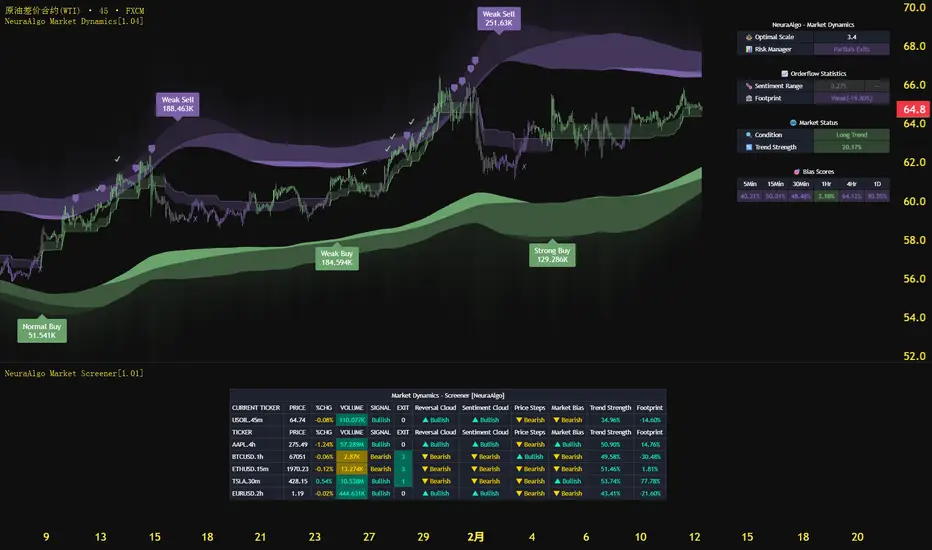
原油 CRUDE 行情大局以及趋势分析大局趋势:牛市,且未进入超买区(OB)。在周线的浪上,一个关键因素是:当前的上涨是推动浪,这意味着任何形成的高点都应只是周线 W.1或 A 浪。
关键阻力:在短期形态位置明确之前,应关注关键回撤位,这些位置至少可能形成暂时性阻力:66.69 (50%) reached , 66.69(50%)已达到,69.45 (61.8% Ret) 69.45(61.8%回撤位))。
关键支撑:日线收盘低于58.38,即12月23日的收盘价(由于短期形态的位置未按预期发展,我已将该支撑位从上周进行调整。)。
关键因素:当前附近形成的任何顶部,都应只是 W.1或 A 浪,属于暂时性顶部 ,任何下跌都应是多头趋势中的第2浪或B浪修正(周级别非日线),而该多头趋势可能仍将持续数月。
⚠更多交易分析及工具可以关注 NeuraAlgo 进行查看!
你是交易员还是一个赌徒? # 26-2-10|BTC · ETH · 黄金1 BTC
首先能看见一个蓝线预警,代表潜在顶部,我们能看见行情形成一条趋势线1,注意趋势线1的中间,曾经被一根阴线和阳线短时间突破过,会有部分观点认为这里的趋势线不再成立。
但我们在实盘中,没有那么多标准的教科书行情,经常会遇到这种突发情况,或者稍微有一点越界的样子,怎么判断?对趋势线的理解是,它本质上是一种短期共识的表现。当这种共识还在,趋势线就有效;当共识消失,线自然会被破坏。本质上是短期内的市场认同,那我们看到趋势线1的这个小幅度破位,阴线的收线价格刚好碰到趋势线,之后的阳线没有太长下影线,属于比较干脆的向上反弹,所以这里并未构成趋势线的破坏(真正的趋势线破坏在实盘中也存在,我们以后遇到了会讲)。
这一段趋势线在a点被阴线向下突破,这里的阴线几乎都是实体,向下突破很干脆利落,因此这里是一个多转空的结构确认点。
同样,我们可以通过后面的走势看出来,在这种正确的位置选择跟随市场合力,市场会给到很大的止盈空间。
之后盘面上的走势较为复杂,这一波粉色底部预警线持续了很长时间,我们把行情拆开逐一分析。
趋势线2:趋势线很标准,没有被破坏,而且经过了市场的验证,在b点向上突破。但我们注意b这条线,小实体,而且上影线长度几乎等于实体,再加上收线价格离趋势线非常近,这里就不是一个干脆的突破,换句话说,我们无法在这里看出很强的多方动能,所以这里的机会应该放弃,继续观望。
趋势线3:果然b点之后行情继续反转,然后形成了趋势线3,底部连个十字星,这里是很多人会选择抄底的入场点,但别着急,很多人这么想,很多人不一定对。我们看见c点向上突破,但c点的问题和b点是一样的,小实体k线,上影线长度几乎和实体相同,虽然突破趋势线的幅度比起b点更多一些,但还是无法看出明显的多头动能,因此这里也是应该放弃的机会。(在《日本蜡烛图技术》一书中,把十字星作为一种反转信号看待,这种观点有一些过时,考虑到书的年代,我们在实盘中应该更灵活才对,这种经典理论仅仅是理解背后的原理,作为参考即可。)
趋势线4:c点向上突破失败之后形成了新的趋势,这条趋势线也由市场验证过,属于合格的趋势线,在d点向上突破,这个d点是满足条件的入场点,但不算太优质,原因是虽然向上突破了趋势线,且实体占优,但和此处附近的空方动能相比,没看出太大的优势,我们这种分析方法,最重要的一点就是找到市场合力改变方向的位置,所以盘面上表现出的动能非常重要。d点动能略低于附近的阴线,因此这里是否判断入场点,取决于个人的风险偏好,风偏较高,可以选择入场,风偏谨慎,也可以选择观望,没有绝对的对与错。
趋势线5:d点向上突破之后,再次反转向下,但这里我们能看出空方衰竭的k线状态了,形成了趋势线5,并且由e点向上突破,通过对比d或者e我们能发现,e的动能明显变高,一个最简单的判断方法,d是比不过附近阴线的,但e明显是更强的,所以通过对比我们能得出,e点才是这里反转动能最佳的结构转换位置。
2 ETH
很长一段时间内没看见任何反转预警信号,这种时候就不应该判断入场,因为没有反转预警的行情很有可能是一段横盘震荡。
随后在趋势线1的位置产生了底部反转信号,但我们要注意的是趋势线1并没有向上被突破,反而是在a点向下加速了,之后从a到b这一段,其实不构成趋势线,有很多人会误认为2是一条趋势线,但我们要注意a之后的k线并没有触及到2,如果按照我对趋势线的要求来看,2 这条线并不成立。
3这条线也是非常容易引起误解的,底部有信号,而且也能画出这条线,表面上看起来还经过的市场的检验,但我们很容易发现这里的行情其实不受3的压制,中间有一根大阴线直接让价格偏移了,这里的走势类似于一个三角形。在我看来,3 这条线并不够干净,我会选择放弃这种结构。
最终形成了趋势线4,我们能看出来经过了市场的检验,没有像1那种突然加速,也没有像3那样走出一个三角形的走势,随后在c点被突破,突破的阳线实体为主,几乎没有影线,而且力度超过了附近所有阴线,这里就是一个标准的空转多的机构转换点。
最后有一小段见顶信号,盘面上标记5的位置,但我们会发现这里的行情变化太迅速,导致无法画出趋势线,所以这个机会同样也应该放弃。
3 黄金
今天的黄金非常值得复盘和学习,其中包括对趋势线的理解,以及大多数人在复盘时都容易犯的一个错误。
首先能清楚看见一个粉色信号,而且形成了趋势线1,而且由a点向上突破,这个突破不同人眼中会有不同的分析,激进派会认为这里能算是一个明显的突破,而且实体为主,可以算作一个标准的空转多信号,保守派会认为a的实体略小于前一根阴线,所以还不足以判定多方动能占主导地位。这两种看法没有对与错,因为这涉及到不同人的风险偏好有区别,交易风格也不同,不管哪一种看法,只要逻辑通顺,符合自己的交易风格就是可以成立的。
然后我们注意到,a点之后产生了两个小实体阴线,实体逐渐缩小,低点逐渐抬高,这里显然是一个空方动能衰竭的具体表现,之后由b点向上发力,突破了a以及后面的两个小阴线,b点位置不管用什么思路来判断,都可以算是一个空转多的确认点了,a点的确定性如果是50%,b点的确定性至少有90%。
我们真正应该注意的是晚一些时候,顶部产生预警的这一段,我们能勉强画出一个趋势线2,但经过前面的复盘学习,我们可以看出,这里的k线反复向上跳跃,试图离开这条趋势线,形成了上下上下的震荡现象。
这里的波动几乎可以肯定是晚上要发布重要数据引起的,这也是大多数人会有的一个误区,也是非常容易犯错的地方。在网络上有很多人会为了博眼球或是证明自己,每次在发布重要数据之前或是重要会议之前,对即将发布的内容做出预测,并给出自己的提前预判。但实际上每次的市场是充满了随机性和很多不确定的,难道我们能预测鲍威尔会说“Good afternoon”还是“hello everyone”吗?其实无法确定的,每一次在这种重大数据即将揭幕的时候,很多人都喜欢去猜测,但这种行为和赌博没有区别,因为这里的波动足够大,如果猜对了会有很多的奖励,但问题是如果猜错了很可能会遇到爆仓的结果。即便一次能猜对,能保证每一次都对吗?一旦错误,后果对我们的账户来说是无法承担的。
不知道大家是否了解期权,在期权中有一个重要的数据叫隐含波动率,每当这种重大消息即将发布的时候,隐含波动率都会显著上涨,这会导致期权价格跟着上涨,不管买权还是买权都是,这种时候最好是空仓观望,不要交易,因为隐含波动率的上升会导致成本显著增加,数据公布之后波动率会直线下降,从而付出了额外的成本去购买这种潜在的预期,这是非常不划算的一件事。
虽然这里不是期权市场,但我们可以用这种思路来帮助我们正确理解和看待这种特殊的行情。新的会议内容和数据我们任何人都无法预测准确,这里是很多赌徒都爱参与的随机震荡行情,而且震荡幅度会很夸张,作为稳健的交易者,我们应该主动避让这种区域,十赌九输!
我们从盘面上的表现来看,趋势线2由a点向下突破,但注意到a点是一根小实体,长影线的形态,上下影线加起来甚至超过的实体的两倍!这种k线形态也足以说明此处多空双方处于剧烈博弈的僵持阶段,尽管随后的b点又是一根阴线,看似是选择了向下的方向,但b点也带有较长的下影线,而且此处非常临近非农数据发布时间,随时有可能会发生巨幅的波动,这种环境下,我个人更倾向于选择观望。
注意,很多人喜欢在数据公布前给出预测。但这种行情对我来说更像随机波动,我不太愿意参与。
我是站在一个稳健型职业交易者的角度给你提出的这个建议,哪个建议更好,经历多了你自然会明白。
# 26-2-10 Market Rewards: Following Structure, Not Prediction1 BTC
First, at point 1, we can see a blue-line top warning. However, a closer look shows that due to the impact of a large bullish candle in this area, it is impossible to draw a valid trendline. Without a valid trendline, trendline-based analysis does not apply.
In addition, this kind of sudden expansion in candle body usually represents a sharp increase in strength from one side of the market, which introduces a high level of uncertainty. For this reason, it is best to stay away from such situations.
Later, trendline 2 is formed. This is a trendline that has been tested and confirmed by the market, and it is broken to the downside by a clear bearish candle. This becomes a higher-probability transition point from bullish to bearish.
It is important to note that the two doji candles before the break do not have a negative impact here. Generally speaking, if the breakout candle itself is a doji, or if the breakout is weak and followed by doji candles, the setup should be avoided. In this case, however, the situation is completely different.
The two doji candles represent disagreement and active negotiation between buyers and sellers. After that, a decisive bearish candle appears, with a strong body and almost no wicks. This indicates that after the struggle, sellers clearly won and chose a definite direction. The subsequent bullish retracement candle is only about half the size of the breakout bearish candle, further confirming that bearish market consensus is dominant at this point.
This clearly shows how much profit potential the market can offer when we choose to follow price at the correct point of market consensus.
After that, a new pink thick-line bottom warning appears, indicating a potential bottom. Price then forms a new trendline, labeled trendline 3. However, when we examine the breakout, although the candle body has some strength and is not a doji-type indecision candle, the closing price does not break clearly above the trendline. Instead, it only marginally exceeds it.
Compared with the breakout of trendline 2, it is obvious that the reversal strength here is limited and lacks conviction. This suggests that the bullish side does not hold a strong advantage at this location.
Later, another pink thick-line bottom warning appears. However, due to the influence of a suddenly enlarged bearish candle, no valid trendline can be drawn. Since trendline analysis cannot be applied here, this potential reversal should also be ignored.
2 ETH
ETH develops in a similar way to BTC, but with some differences in detail.
First, we again see a blue-line top warning, indicating a potential bearish reversal. At area 1, a sudden large bullish candle appears, making it difficult to draw a valid trendline. We continue to observe.
Soon after, a market-tested trendline 2 is formed. Several indecision candles appear near the top, and after this period of negotiation, a decisive bearish candle breaks the trendline to the downside. This becomes a relatively high-probability bearish market consensus point.
Again, we can see that when we choose the correct market consensus point, the market is capable of delivering substantial profit potential.
In contrast, trendline 3 presents a very different situation.
Later, another pink thick-line bottom warning appears, indicating a potential bottom, and a new trendline 3 is formed. When this trendline is broken, the bullish candle shows a noticeable body, but the upper and lower wicks are even more prominent. The combined wick length is clearly greater than the candle body.
This type of candle represents intense buyer–seller conflict. If we only look at this breakout in isolation, it may seem confusing. However, once we compare it with the breakout of trendline 2, the difference becomes very clear: what a clean, high-probability breakout looks like, and what a breakout still dominated by indecision and conflict looks like.
By comparing reversals at points 2 and 3, we can see that choosing the right location leads to completely different profit potential afterward. In real trading systems, this directly translates into a major difference in risk-reward ratio.
3 Gold
First, a blue-line top warning appears, indicating a potential bearish reversal. A clear trendline 1 is formed and is broken to the downside by a bearish candle with a solid body. This structure is very standard and can be considered a textbook model, so it does not require much explanation.
Price then pulls back upward and produces another blue-line warning. A new trendline 2 is formed, and after two doji candles showing buyer–seller negotiation near the top, price is again broken downward by a bearish candle. This is another textbook example.
Later, a pink thick-line bottom warning appears, marked as point 3 on the chart. However, due to a suddenly enlarged bearish candle, no valid trendline can be drawn. As a result, trendline analysis cannot be used to identify a valid entry here, and this reversal opportunity should be abandoned.
Finally, another blue top warning appears, and a clear trendline 4 is formed. Although the breakout candle is bearish with a visible body, its closing price lands right on the trendline, making the breakout weak rather than decisive. The following candle suddenly expands and contains a long lower wick, which makes it unsuitable as an entry point. Therefore, this setup should also be avoided.
It is important to note that this analysis is strictly based on the current timeframe. If we move down to a lower timeframe, new trendlines and better breakout points may appear. This is one way to search for optimal entries. However, it must be emphasized that traders should analyze and trade within the same timeframe. Mixing multiple timeframes too freely often leads to over-complication and interferes with sound decision-making.
Summary
We should note that although the breakouts at points 1 and 2 in gold look very similar structurally, the profit potential provided by the market afterward is completely different.
This is exactly what I keep emphasizing: the future path of the market is never predictable. Even if we choose a correct entry point, price may reverse at any moment, creating floating losses, or it may suddenly expand and generate significant unrealized profits. All of this is unknown.
What we can do is simply follow the market at the correct entry points. As for how far price will go, that inevitably involves a certain degree of luck. This is the correct mindset required when using any trading system. Setting rigid expectations such as “how much profit I must make” or “how many times I must multiply my capital” only leads to psychological pressure, mistakes, and distorted decision-making.
The red and blue lines mentioned in this article are used solely to mark structural positions on the chart. They do not constitute trading advice and do not represent any specific indicator or tool.
跟随市场,但无法预测 # 26-2-10|BTC · ETH · 黄金1 BTC
首先在1的位置看见了蓝线的顶部预警,但我们仔细观察就会发现,1附近由于大阳线的影响无法画出有效的趋势线,那也就无法用趋势线理论进行分析,而且这种突然增大实体的k线代表某一方力量的激烈增大,充满不确定,所以最好避开。
然后我们可以看见形成了趋势线2,这是一条经过市场检验的有效趋势线,而且被一根明显的阴线向下突破,这里就是一个确定性更高的多转空转换点。注意这里的两个十字星并没有负面影响,因为突破线并不是十字星,一般来说如果突破线是十字星,或是突破线很勉强,之后出现了十字星,都会建议放弃机会,但这里的情况完全不同,先出现两个十字星,代表多空的分歧和博弈状态,但之后出现一个肯定的、干脆的实体阴线,几乎没有影线,说明经过博弈之后空方胜出,选择了一个明确的方向,随后的小阳线反弹只有这个突破阴线的一半大小,也说明了这里的空方市场合力占优。
我们可以清晰看出,在正确的市场合力位置选择跟随之后,市场能给到多少的利润空间。
随后形成了新的底部粉色粗线预警,代表潜在的底部,对应的k线走出了一段趋势线行情,标注为趋势线3,但我们要注意这里的突破位置,虽然实体占优势,不属于十字星的博弈k线,但是收线价格并没有明显突破趋势线,而是刚好略微超出了趋势线,这种突破和前面的趋势线2突破位置相比,能明显看出这里的反转力度有限,态度不坚决,也就说明了这里的多方优势并不大。
后来又出现了一段底部的粉色粗线预警,但这里对应的k线也是由于一根突然增大的阴线影响,无法画出趋势线,无法用趋势线做分析,所以这里也是放弃的。
2 ETH
和大饼发展出了类似的走势,但细节不同。
首先也看见了蓝线标出的顶部预警,代表潜在的向下反转机会,区域1也是一个突然增加的大阳线,让这里很难画出趋势线,继续观察,稍后形成了一条经过市场检验的趋势线2,并在顶部产生了几根博弈k线,在博弈k线之后由一根坚决的阴线选择向下,因此这里也是一个确定性较高的空方市场合力点。
同样我们能看出,选择正确的市场合力点之后,市场其实能给到很多的利润空间。
和这里相比,趋势线3就很不一样了:
之后的行情又形成了一段底部粉色粗线,代表潜在底部,而且形成了趋势线3,但我们注意趋势线3被突破的位置,阳线的实体比较明显,但上下影线更明显,上下影线长度加起来明显超过了实体长度。这种k线类型属于多空博弈剧烈的情况,如果单独看这里的突破,可能会有一些不理解,但我们一旦和趋势线2的突破做一个对比,就能清晰看出什么突破才是干脆的、确定性高的,什么突破又是多空其实还在博弈阶段、确定性比较低的。
对比2和3这两个反转,我们可以看出来:选择正确的位置,后续市场带来的利润空间完全不一样,这在外面交易系统中就会给到我们区别很大的盈亏比。
3 黄金
首先是顶部蓝线预警出现,代表潜在空方反转。然后可以清晰看见一条趋势线1,并由一根实体阴线向下突破。这里的结构非常标准,属于教科书级的模型,所以不用过多解释了。
随后再次向上回调,再次产生蓝线预警,而且又产生一段新的趋势线2,而且在顶部经过两个多空博弈十字星之后,被阴线向下突破。这里也是一个教科书级别的模型。
随后出现了底部的粉色粗线预警,在盘面上标记为3,但要注意这里由于突然增大的阴线,我们无法画出任何趋势线,因此这里无法用趋势线判断一个有效的入场位置,需要放弃这里的反转机会。
最后产生了顶部的蓝色预警,在盘面上也走出来一个明显的趋势线4,这里的趋势线突破虽然是一个实体阴线,但注意收线的位置,刚好落在趋势线上,不算很强势的突破,随后的一根k线又是突然增大,而且带着很长的下影线,不适合作为入场点,所以这里是需要放弃的。但是要注意,这种分析是只针对本级别周期的判断,这里如果进入更小周期查看,很可能又存在新的趋势线和更好的突破位置,这也是一种找到最佳入场点的思路,但需要强调的是,在哪一个周期内交易,就分析哪个周期的图形,如果跨周期进行多个分析,很容易让自己的判断变得过于复杂,从而干扰正常判断。
总结
我们需要注意,黄金1和2的突破虽然模型很相似,但后续市场给的利润空间完全不同。这就是我不断强调的:市场如何发展我们永远无法预测,哪怕我们选择正确的入场点,也可能随时会遇到反转让我们产生浮亏,或者遇到行情突然增大给到我们极大的浮盈,这都是未知的情况,所以我们只能在正确的入场点选择跟随市场,至于止盈能到哪,这就需要一点点运气了。这也是我们使用交易系统的时候需要的一种正确心态,而不是我入场必须拿到多少利润,我要翻多少倍,陷入这些错误的目标里只会让自己的交易出现问题,容易犯错。
文中提到的红线、蓝线,仅用于标记图表中的结构位置,并不构成交易建议,也不代表任何具体指标或工具。
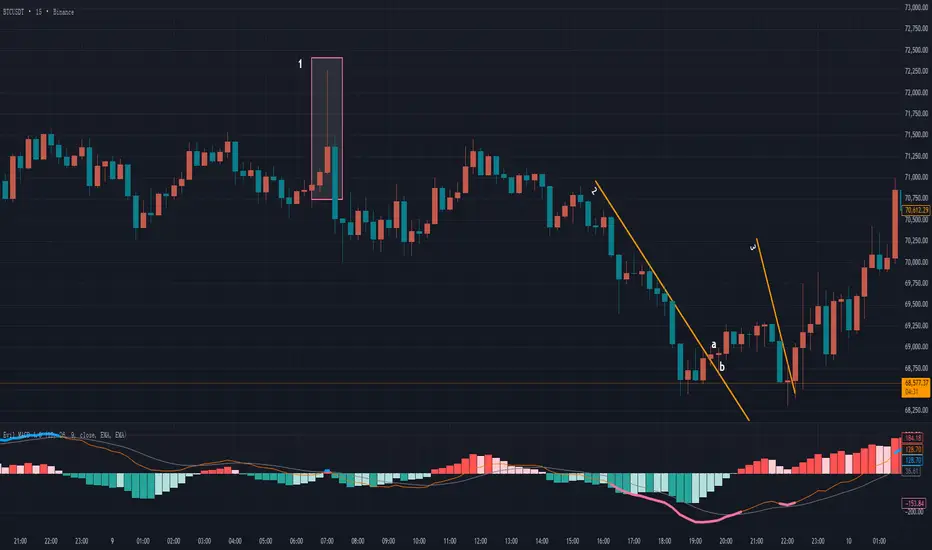
When You Can’t Draw a Trendline, Trading Becomes GamblingWhen a market structure does not allow a valid trendline to be drawn, trading in such conditions is essentially no different from gambling.
In today’s session, the market repeatedly presented areas that looked like opportunities, but where the structure was not actually valid.
This review is not about teaching you how to enter trades.
It is about teaching you when to stay out.
1. BTC
First, we see the initial blue top warning signal, marking Area 1 (highlighted by the pink box).
This is a zone where no valid trendline can be drawn.
Pay close attention to the large bullish candle with an extremely long upper wick.
Even if a trendline could be forced onto this structure, such an extreme price move introduces randomness and instability into the market.
Although strong bearish momentum followed (the large bearish candle with a long body), this still does not justify a short entry.
This is a high-risk consolidation zone, and staying out is the best decision.
Later, a long red warning sequence appeared, indicating a potential bottom.
Price then developed Trendline 2, which was broken at point a.
First, Trendline 2 itself is not high quality.
Before point a, price formed a triangular structure that clearly deviated from the trendline.
This is a 15-minute chart — a cleaner trendline may exist on a 5-minute or lower timeframe.
The key principle here is simple:
trade only the timeframe you specialize in.
If a valid trend cannot be identified on your chosen timeframe, do not rely on lower timeframes to justify an entry.
Second, candle a has a small body with upper and lower wicks, very close to a doji.
Candle b has an even smaller body with a long lower wick.
Although price broke above Trendline 2, there is no clear bullish momentum.
Therefore, neither a nor b qualifies as an optimal reversal entry.
Later, another thick pink line appeared, indicating a potential bottom, followed by a doji and an upward break.
However, the line marked 3 does not form a valid trendline.
This line has not been properly validated by the market.
This is a very common situation: forcing a setup simply because we want to trade.
Lowering entry standards in order to participate — trading for the sake of trading — is the root cause of many losses.
The correct approach is to rely strictly on objective conditions.
When conditions are not met, the correct action is to pass.
Remaining flat and reducing stop-loss exposure is a core trading principle.
As before, while a valid trendline may exist on a lower timeframe, none is confirmed on the current timeframe.
If you want to trade, you must shift to a lower timeframe — the logic remains the same.
Only follow entries that fully align with your trading system.
2. ETH
At the beginning, we again see low-quality trend structures.
At Trendline 1, although a trendline can technically be drawn, both the first and third candles have very long wicks.
This indicates extreme behavior from both buyers and sellers.
Even with pink or blue warning signals, this type of market should be avoided.
Later, a pink bottom warning appeared.
However, in Area 2, no valid trendline can be drawn.
Line 2 simply connects two arbitrary points and does not represent a true trend.
In this case, trendline theory cannot be applied.
Trendlines 3 and 4, however, are very different.
For Trendline 3, a pink bottom warning appeared and price broke upward at point a.
Candle a still has a small body and weak bullish momentum.
By waiting briefly, a strong bullish candle b appeared.
This represents a clearer and more reliable bullish market consensus.
This is a valid system-based entry.
Whether profits were managed with a trailing stop or stopped out due to delayed stop movement, this trade falls entirely within the rules of the trading system.
Later, Trendline 4 formed, accompanied by another pink bottom warning.
Price broke upward with a strong bullish candle, once again forming a high-probability bullish consensus.
Following this setup provided significant upside potential.
3. Gold
Today, only one blue top warning signal appeared.
In Area 1, the large bullish candle reflects strong bullish momentum.
However, buying pressure suddenly disappeared, followed by several candles with long wicks — a clear sign of intense two-sided conflict.
More importantly, no valid trendline can be drawn.
The two yellow lines shown on the chart are not standard trendlines.
The inability to form a proper trendline is primarily caused by the large bullish candle.
When markets experience such sudden price expansions, directional judgment becomes extremely difficult.
Entering trades under these conditions is no different from gambling.
Protect your capital. Stay away from gambling behavior.
Summary
Today’s market clearly demonstrates the difference between entering at standard, high-quality setups and entering at forced or substandard locations.
When trades are taken from weak structures or barely valid trendlines, random market noise often triggers stop losses.
When entries are taken in alignment with true market consensus, losses are still possible — but the probability of success increases significantly.
Most importantly, the risk-to-reward profile becomes decisively favorable.
入场点的对与错# 26-2-9|BTC · ETH · 黄金画不出趋势线的行情,本质上和赌博没有区别。
今天的盘面,多次出现看似有机会、但结构并不成立的区域。
这篇复盘的重点,不是教你进场,而是教你在什么时候选择放弃。
1 BTC
首先我们看见了第一段蓝线标出的顶部预警,这里标记了一个区域1(粉色方框里),这里是无法画出趋势线的,注意那根上影线很夸张的阳线,即便能画出某根趋势线,这里的行情也会受到这种极端行情的影响,变得随机和不可控,哪怕这里在上影线之后出现了很强烈的空方动能(那根实体很长的阴线),也不能判断一个空方的入场,风险非常大的震荡位置,放弃是最佳选择。
之后盘面上出现了大段的红线预警,代表潜在的底部,行情随后发展出了趋势线2,趋势线由a点突破。
第一,趋势线2并不是质量很好的趋势,我们可以注意a点之前的那个三角形区域,这里明显在脱离趋势线,这是15分钟级别,这里有可能存在标准的趋势线走势,但这种走势很可能在5分钟或者更小的周期里面才能看出来,因此选择自己擅长的周期,如果在当前周期内交易,就先不考虑其他周期内的趋势。
第二,a是一个小实体,带上下影线的形态,很接近十字星,b是一个实体更小,下影线较长的形态,虽然是向上突破了趋势线2,但无法看出很强的多方动能,所以在a和b两个位置,都不是最佳的反转入场点。
之后又看见了一条粉色粗线,代表潜在的底部,形成一个十字星之后向上突破,这里标出3的这根线,仔细看一下并不构成趋势线,因为这根线其实没有经过市场的验证,这也是在盘面上经常出现的一种情况,我们不能因为自己想做交易,就降低判断入场点的标准,这叫为了入场而入场,很多亏损都是这种操作导致的,正确的做法应该是只看客观条件,当条件不满足的时候就放弃机会。
宁愿空仓,也要减少止损的机会,这才是正确的交易理念。
当然,这个位置和前面一样,当前周期内没有判断出趋势线,很可能在更小的周期里面又存在,那就应该去更小的周期内交易了。核心是一样的,判断符合交易系统的入场点进行跟随。
2 ETH
刚开始也出现了前面那种质量很差的趋势。比如在趋势线1的位置,虽然明显可以连成趋势线,但注意其中第一条和第三条k线都属于影线很长的k线,这里多空双方都容易走极端,这种行情虽然能画出趋势线,虽然有粉色或蓝色预警信号,但我们应该放弃。
随后又出现了粉色标出的底部预警,但我们注意区域2,同样是无法画出趋势线的,2这条线只是随意连接了两个点,是无法画出趋势的。所以这里无法用趋势线理论进行分析。
3和4这两条线就很不一样了:
趋势线3,底部出现了粉色线预警,行情由a点突破,但a是一个小实体k线,无法看出较强的多方动能,稍等待一下,马上出现了一个实体阳线b,这里就是一个确定性更高的多头市场合力,可以选择跟随,之后用移动止盈的方法止盈,或是没有及时推止损线而导致止损,不管哪种情况,这里是交易系统之内的入场点。
随后出现了趋势线4,而且产生了一段粉色预警线,代表潜在的底部反转,然后由一根实体阳线向上突破,这里同样是一个确定性更高的多头市场合力点,可以选择跟随,之后的行情给到了很多的多头空间。
3 黄金
今天只产生了一段蓝色顶部预警信号,我们仔细观察这个区域(图中标1的位置),大阳线表示强烈的多头动能,但多头进攻意愿突然消失,相继形成了几个带有长影线的形状,代表多空双方激烈博弈的过程。
更关键的一点:这里无法画出合格的趋势线,注意图中的两根黄色画线,都不属于标准的趋势线,这里画不出趋势线的原因主要是那根大阳线导致的,所以当市场出现这种突发行情的时候,我们很难判断一个正确的方向,这种时间入场和赌博有什么区别呢?珍爱生命,远离赌博。
总结
通过今天的行情分析,我们可以看出在标准的入场点和不标准的位置入场,区别有多大,当选择了一个质量欠佳、趋势线都很勉强的位置,很容易被市场随机震荡打到自己的止损,但如果选择正确的位置跟随市场合力,同样也有可能止损,但是获胜的概率明显增大,最关键的一点是盈亏比是对我们极其有利的。
黄金GOLD趋势与基本交易策略周线复合:周线空头反转,在周线低点完成之前,趋势应⾄少横盘⾄下⾏2–3周。(熊)
日线复合:在日线⾼点与小型修正完成之前,短期趋势应为横盘⾄上涨。(牛)
关键因素:黄⾦和白银已经形成了教科书式的衰竭性反转,这应当完成⼀个多周,甚⾄多月级别的顶部。任何上涨都应属于周线,甚⾄月线熊市趋势中的小型修正。
交易策略建议:黄⾦和白银应在下周完成日线⾼点,随后恢复周线熊市趋势。鉴于波动性较⾼,目前没有具体交易策略,和特别好的机会,但TradingBox会尽⼒在其处于完成小型修正⾼点的位置时进⾏识别,以便你在愿意的情况下加以利用。
⚠ 短期交易者应以TradingBox信号系统为准!
Not All Breakouts Are Equal: How to Identify High-Quality MovesThrough today’s market analysis, we can deepen our understanding of market consensus and better distinguish what actually constitutes a high-quality breakout.
1️⃣ BTC
At trendline 1 and trendline 2, BTC printed two pink warning signals, indicating potential bottoming areas.
The key here is to compare the quality of the breakouts from these two trendlines.
Starting with trendline 1, upward breakout attempts appeared at both point A and point B.
However, a closer look reveals that at point A, the combined length of the upper and lower wicks exceeds the candle body. Although this is not a doji, such long wicks clearly reflect intense competition between bulls and bears.
At point B, the candle has a long lower wick. In some theories, a long lower wick is interpreted as a sign of bullish strength. However, the existence of the lower wick itself means that bears were still actively pushing price lower and at least managed to reach that level.
Therefore, whether at point A or B, neither breakout can be considered clean or decisive.
As a result, neither A nor B qualifies as a high-quality entry point.
When clear two-sided conflict appears on the chart, the correct response is to remain patient, or to reduce position size and leverage. These types of entries are suitable only for probing or trial trades, and they lack strong follow-through value.
Now looking at trendline 2:
Although this trendline was not previously tested by the market, the breakout at point C was clean and decisive, with almost no visible signs of struggle between bulls and bears.
While C does have a very small upper wick, a direct comparison with points A and B shows that the bullish strength at C is overwhelmingly dominant.
Therefore, point C represents the highest-quality entry among the three.
Additionally, from a Wyckoff perspective, we can observe that before points A and B, there was no terminal shakeout. The large bearish candle below trendline 2 can be interpreted as a Wyckoff “selling climax” or terminal shakeout, and many reversals originate from such events.
2️⃣ ETH
ETH first formed a long pink warning zone, signaling a potential upside reversal at any time.
A trendline then developed, and although it was broken upward by a small bullish candle near the end, this breakout deserves caution.
The breakout candle itself had no long wicks and appeared clean. However, within the pink boxed area ahead, we can see a large number of candles reflecting intense two-sided trading.
Price action in this area did not strictly respect the trendline; instead, price detached from it at multiple points. This suggests that the trendline did not exert strong structural pressure, reducing the significance of the subsequent breakout.
This area therefore represents a risk zone. In such situations, it is better not to rush into a position, but to observe further, or—as with BTC—to reduce leverage and position size and treat it as a trial entry.
Later, trendline 2 formed. Compared with the first trendline, price action respected this one much more closely.
There was no choppy back-and-forth like in the earlier pink box, and price did not deviate far from the trendline. As a result, trendline 2 carries greater structural validity.
When trendline 2 was broken by a strong bullish candle, this became the most attractive long opportunity.
However, another issue must be considered: such sudden, powerful breakouts significantly expand the stop-loss distance.
Therefore, even if choosing to follow this move, leverage and position size must be reduced, as market direction is never predictable and reversals can occur at any time. In trading, risk always comes first—this principle is never wrong.
Afterward, a short blue warning zone appeared, marking a potential top (highlighted by pink box 3).
Notably, no valid trendline formed here. Instead, the structure consists of a sudden large bullish candle followed by a bearish doji.
As such, this segment cannot be analyzed using trendline theory.
3️⃣ Gold
We first observe a thick pink line indicating a bottom reversal warning.
A trendline then formed and was tested by the market. At point A, price broke above the trendline. Although the candle at A has a lower wick, the candle body is larger than the wick, making the negative impact of the wick negligible.
This can be viewed as a structural transition from short to long.
However, since the upward breakout was not particularly strong—the closing price was only slightly above the trendline—whether to follow this move depends on individual risk tolerance.
More aggressive traders may choose to follow market consensus, while more conservative traders may opt to skip this opportunity.
Later, a short blue top warning appeared, followed by the formation of trendline 2.
At point B, price broke downward. The candle at B is a nearly full-body bearish candle with minimal wicks and clearly breaks the trendline, making it a high-confidence structural shift from long to short.
After entering in the direction of market consensus at B, price later reached area C, where profits should be protected.
If bearish consensus were truly strong, price would have moved quickly. Instead, area C shows two doji candles, followed by small-range candles, indicating that bearish consensus either failed to form or suddenly dissipated.
This candle behavior clearly reflects indecision or mutual disengagement between bulls and bears.
Summary
By comparing today’s market structures, we can see that randomness is always present.
Even when we correctly identify a structural shift aligned with market consensus, it does not guarantee that price will continue moving smoothly in that direction.
Remember this key principle:
We can identify market consensus—but how far that consensus will carry price is impossible to predict.