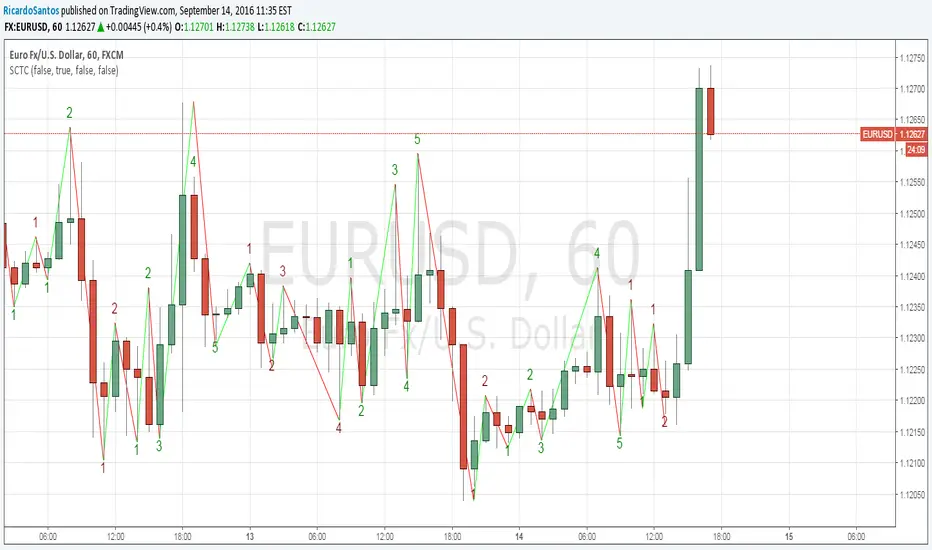
[RS]Swing Charts V0 Trend Counter V0EXPERIMENTAL:
wave counting using swing charts, use at your own discretion.
在脚本中搜索"wave"
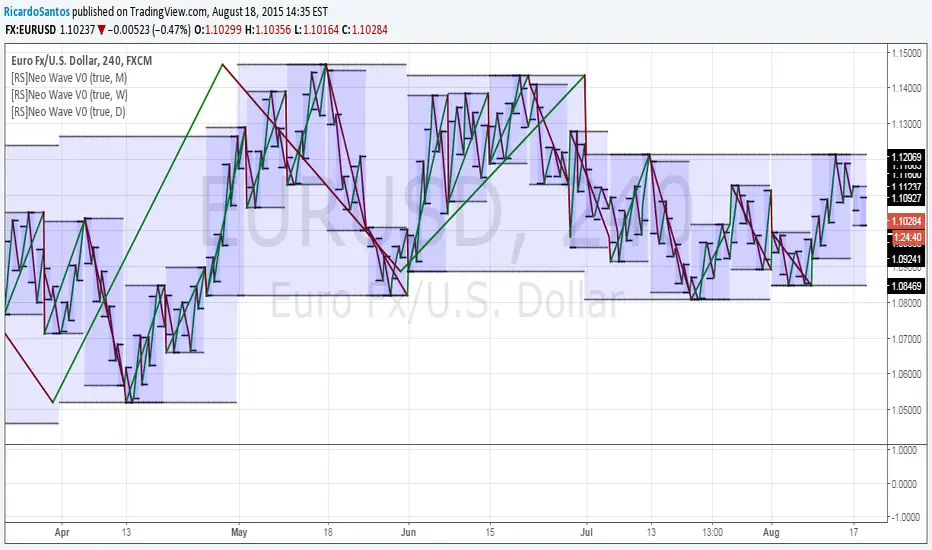
[RS]Neo Wave V0EXPERIMENTAL: Request for IvanLabrie.
Method for reading Neo Wave's.
note: some issues arent possible to work around/fix due to limitations in pinescript.
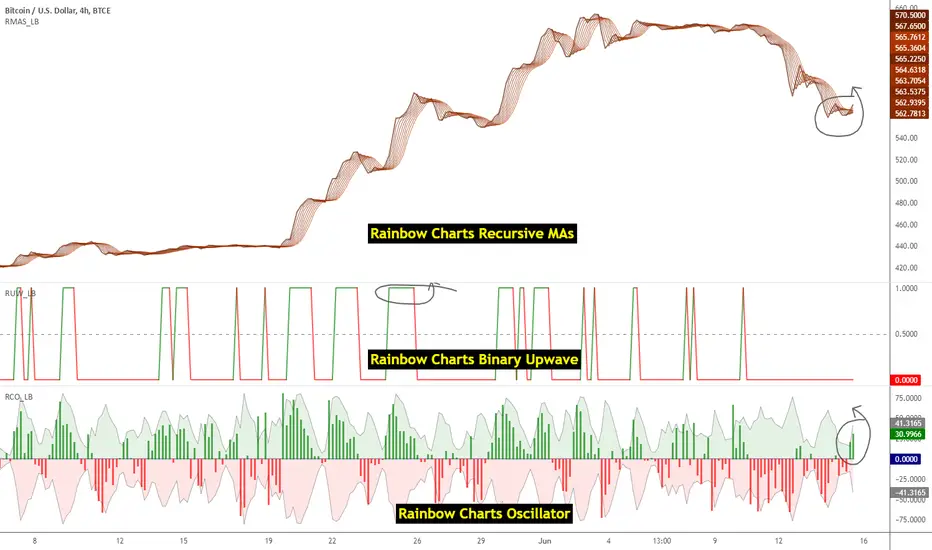
Indicators: Rainbow Charts Oscillator, Binary Wave and MAsRainbow Charts, by Mel Widner, is a trend detector. It uses recursively smoothed MAs (remember, this idea was proposed back in 1997 -- it was certainly cool back then!) and also builds an oscillator out of the MAs. Oscillator bands indicate the stability range.
I have also included a simple binary wave based on whether all the MAs are in an upward slope or not. If you see any value above 0.5 there, the trend is definitely up (all MAs pointing up).
More info:
www.traders.com
Here's my complete list of indicators (With these 3, the total count should be above 100 now...will update the list later today)
Candle Density Indicator_SH_v1This indicator visually highlights the price zones where candlesticks have most frequently passed, using box shapes.
Unlike a standard volume profile, it focuses soley on the areas most visited by candlestick bodies, displayed as gray boxes, and marks the highest and lowest prices within each zone. Additionally, it features a highlight function:
The number displayed inside the gray box represents the average trading volume of the most recent supply zone.
candlestick bodies that exceed the zone's average trading volume are emphasized in yellow.

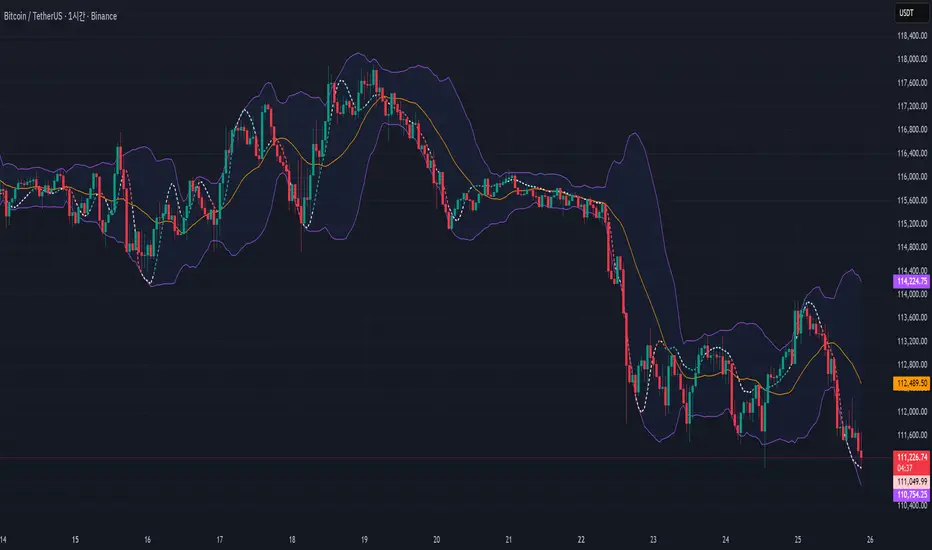
WaveMacBollI wanted to see the two indicators in the candle chart, not in a separate window. And within the Bollinger band, it seemed to put it fine.
Important Note on Line Styles
Due to TradingView's multi-timeframe environment restrictions (timeframe = '', timeframe_gaps = true), I couldn't implement dotted or dashed line styles programmatically. The indicator uses solid lines by default.
If you prefer dotted/dashed lines for better visual distinction:
Add the indicator to your chart
Click on the indicator settings (gear icon)
Go to "Style" tab
Manually change line styles for each plot
Unfortunately, PineScript doesn't support line.new() or similar drawing functions in multi-timeframe mode, limiting our styling options to basic plot styles.
If you know a good solution for implementing dotted/dashed lines in multi-timeframe indicators without using drawing objects, please share it in the comments! I'd love to improve this aspect of the indicator
20 Day Moving Average with Profit TargetsThis Pine Script indicator plots a 20-day simple moving average (SMA) on the chart and displays profit target labels relative to an initial buy price.
The script allows the user to input a custom buy price and calculates profit levels at 10%, 20%, 30%, and 50% above the buy price. Labels are shown on the last bar of the chart for each profit level and the buy price, with the labels offset to the right to avoid overlapping with the price action.
The labels are color-coded based on the profit levels, and the buy price label is blue.

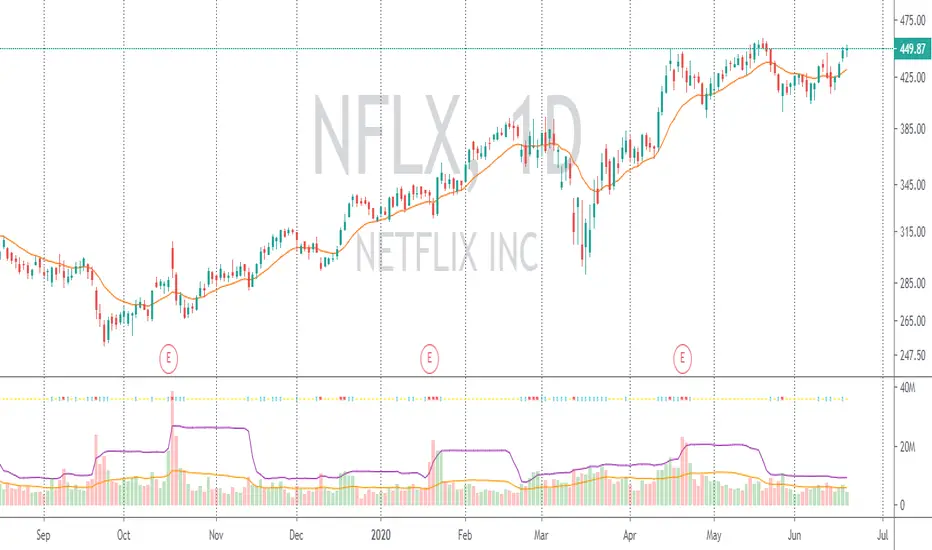
Volume with SD+2Volume with SD+2
Volume with SMA20 and Standard Deviation +2
If Volume < SMA20 , mean Volume Low and less momentum.
If Volume > SMA20 and < SD2 , mean Volume Increase and more momentum.
If Volume > SD2 , mean Volume Climax , show strong trend but show reversal point in someitmes.

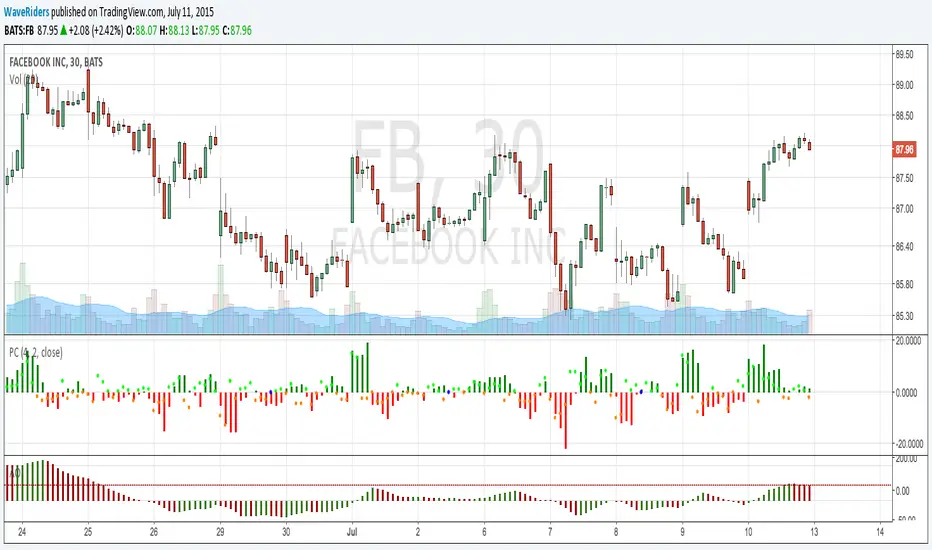
PriceCounterPrice Counter
Use to identify Price Short Term Trend By
PC = Present Close - 4 Previous Close
PC > 0 Show Value in Green bar
PC 0
Dot = Present Close - 2 Previous High
If PC = 0 or < 0
Dot = Present Close - 2 Previous Low
Indicator will Show momentum of price. PC bar is long mean price move fast .
PC bars are the same color continuously , mean price in trend.
PC bars are often flip color and small bar , mean price sideway and weak momentum.
The Zone Trades v1.0The Zone v.1.0
The Zone is mention in New Trading Dimensions by Bill Williams,PhD. The Zone is used for Entry Signal of Both Long and Short side.
Green Zone are painting Green Bars when Awesome Oscillator (AO) and Accelerater/Decelerator (AC) are both increasing.
Red Zone are painting Red Bars when Awesome Oscillator (AO) and Accelerater/Decelerator (AC) are both decreasing.
Gray Zone are painting Gray Bars AO and AC in difference changing. Gray Zone are indicate the indecision between bulls and bears.
Bill Williams, PhD. mention that Green Zone or Red Zone usually happen 6-8 bars Continuously.
The First Bar that change to be Green or Red color is the Signal Bar.
Entry Signal is the second bar in the same color as the Signal bar happen with Volume
Price go higher the high of previous Green Bar is Buy Signal. Entry Buy (Long) and place Stop at 1 tick lower the Low of previous bar.
Price go ;ower the Low of previous Red Bars is Sell Signal. Entry Sell (Short) and place Stop at 1 tick higher the High of previous bar.
Do not Entry if Green Bars or Red Bars completed 5 bars continuously.


🦶🦶 VuManCraigThis script is a community-driven recreation of the popular VMC/Decipher B divergence tool.
Full credit and thanks go to the original authors and contributors from the original indicator comments — this version simply brings the same logic into a cleaner, more customizable format, with default settings adjusted to reflect Craig the Educator’s trading setup.
Features
Detects bullish & bearish divergences on the VMC/Decipher B waveform
Automatic label plotting for clear visual signals
Default parameters tuned to match Craig the Educator’s preferred setup
Adjustable lengths, thresholds and smoothing
Optional oscillator visibility toggles
Alerts for divergence confirmations
Lightweight and optimised for intraday or swing-trading use

Hybrid Flow Master📊 Hybrid Flow Master - Professional Trading Indicator
Overview
Hybrid Flow Master is an advanced all-in-one trading indicator that combines Smart Money Concepts, institutional order flow analysis, and multi-timeframe confluence scoring to identify high-probability trade setups. Designed for both scalpers and swing traders across all markets (Forex, Crypto, Stocks, Indices).
🎯 Key Features
1. Intelligent Confluence System (0-100% Scoring) Proprietary scoring algorithm that weighs multiple factors Only signals when minimum confidence threshold is met
Real-time probability calculations for each setup Signal quality grading: A+, A, B, C ratings
2. Smart Money Concepts (SMC)
Automatic Order Block detection (bullish/bearish) Fair Value Gap (FVG) identification
Market structure analysis (Higher Highs, Lower Lows) Swing high/low tracking with visual markers
3. Multi-Timeframe Analysis
Higher timeframe trend filter for confluence Customizable HTF periods (1H, 4H, Daily, etc.)
Prevents counter-trend trades Aligns entries with major trends
4. Volume Flow Analysis
Volume spike detection with customizable thresholds Volume delta calculations (buying vs selling pressure) Institutional footprint identification Background highlighting for high-volume bars
5. Advanced Risk Management
ATR-based stop loss calculation Automatic take profit levels Customizable risk/reward ratios (1:1, 1:2, 1:3+) Visual SL/TP lines on chart Position sizing guidance
6. Professional Dashboard
Real-time HUD displaying:
Market bias (Bullish/Bearish/Neutral)
Higher timeframe trend status
Current confluence percentage
Volume status (Normal/High)
RSI reading with color coding
ATR volatility measure
Signal quality grade
7. Smart Alert System
Bullish confluence signals
Bearish confluence signals
Volume spike notifications
Customizable alert messages
Works with mobile app notifications
📈 What Makes It Unique?
✅ No Repainting - All signals are confirmed and final
✅ Probability-Based - Shows confidence level, not just binary signals
✅ Multi-Factor Confluence - Combines structure, volume, momentum, and HTF analysis
✅ Clean Interface - Toggle individual components on/off
✅ Works on All Timeframes - From 1-minute scalping to daily swing trading
✅ Universal Markets - Forex, Crypto, Stocks, Indices, Commodities
🎨 Customization Options
Adjustable swing detection length
Volume threshold settings
Minimum confluence score filter
Custom color schemes
Dashboard position (4 corners)
Show/hide individual components
Risk/reward ratio adjustment
ATR multiplier for stops
📊 Best Used For:
✔️ Scalping (1m - 15m charts)
✔️ Day Trading (15m - 1H charts)
✔️ Swing Trading (4H - Daily charts)
✔️ Trend Following
✔️ Reversal Trading
✔️ Breakout Trading
💡 How to Use:
Add indicator to chart - Works immediately with default settings Set your timeframe - Choose your trading style Wait for signals - Green BUY or Red SELL labels with confidence %
Check confluence score - Higher % = better quality setup Review dashboard - Confirm market bias and HTF trend Manage risk - Use provided SL/TP levels or adjust to your preference
Set alerts - Get notified of high-probability setups
⚙️ Recommended Settings:
For Scalping (1m-5m):
Swing Length: 5-7
Min Confluence: 70%
HTF: 15m or 1H
For Day Trading (15m-1H):
Swing Length: 10-15
Min Confluence: 60%
HTF: 4H or Daily
For Swing Trading (4H-Daily):
Swing Length: 15-20
Min Confluence: 50-60%
HTF: Weekly
📚 Indicator Components:
✦ Market Structure Detection
✦ Order Block Identification
✦ Fair Value Gaps (FVG)
✦ Volume Analysis
✦ RSI (14)
✦ MACD (12, 26, 9)
✦ ATR (14)
✦ Multi-Timeframe Trend
✦ Confluence Scoring Algorithm
🚀 Performance Notes:
Optimized for speed and efficiency Minimal CPU usage Clean chart presentation
Limited drawing objects (no chart clutter) Works on all TradingView plans
⚠️ Important Notes:
This indicator is a tool to assist trading decisions, not financial advice Always use proper risk management (1-2% per trade recommended) Backtest on your preferred market and timeframe
Combine with your own analysis and strategy Past performance does not guarantee future results
🔔 Alert Setup:
Right-click indicator name → "Add Alert" → Choose:
"Bullish Confluence Signal" for buy setups
"Bearish Confluence Signal" for sell setups
"Volume Spike Alert" for unusual activity
💬 Support:
For questions, suggestions, or custom modifications, feel free to message me directly through TradingView.

Test shift level strategyTesting this on all timelines where in it checks the candle color and takes call to buy or sell

brrr on $ indicator 𐤀it is an indicator that brrr's too but this one only brrr's on $.
ppl want know more about $ but thats all. it just brrr's $
sometimes it brrr's $ sometimes it wont. but wen it brrr's $ it really brrr's $.
brrr

brrr indicator 𐤀its an indicator that brrr's.
ppl want know more about but thats all. it just brrr's
sometimes it brrr's sometimes it wont. but wen it brrr's it really brrr's.
brrr

RSI with SMA + 70/60/50/40/30 LevelsIndicator Name:
RSI with SMA + 70/60/50/40/30 Levels
🧩 Concept Overview:
यह indicator दो popular tools को combine करता है:
RSI (Relative Strength Index) – momentum indicator जो market ke overbought aur oversold zones ko identify karta hai.
SMA (Simple Moving Average) – trend smoother jo RSI ke movement ko average karke lagging confirmation deta hai.
इन दोनों के साथ 70, 60, 50, 40, और 30 की multiple reference lines draw की जाती हैं, ताकि trader को RSI ke swings aur reversals easily samajh aaye.
⚙️ Indicator Components:
RSI Line:
Default Period: 14 (customize kar sakte ho).
Show karta hai price momentum – agar RSI 70 ke upar jaata hai to market overbought zone me hota hai; agar 30 ke niche jaata hai to oversold zone me.
SMA on RSI:
RSI ka smooth version (usually 9-period SMA).
Trend confirmation ke liye – jab RSI line SMA ke upar cross karti hai to bullish signal, aur neeche cross kare to bearish signal.
Horizontal Levels:
70: Overbought zone (potential sell area).
60: Strong bullish momentum line (trend confirmation).
50: Neutral / midline (trend direction flip area).
40: Weak bearish zone (trend losing strength).
30: Oversold zone (potential buy area).
💡 How to Use:
Trend Identification:
RSI > 60 aur SMA ke upar → Bullish trend.
RSI < 40 aur SMA ke neeche → Bearish trend.
Reversal Spotting:
RSI 70 ke upar jaake wapas niche aaye → Sell signal.
RSI 30 ke neeche jaake wapas upar aaye → Buy signal.
Confirmation Using SMA:
RSI cross SMA from below → Confirmed bullish reversal.
RSI cross SMA from above → Confirmed bearish reversal.

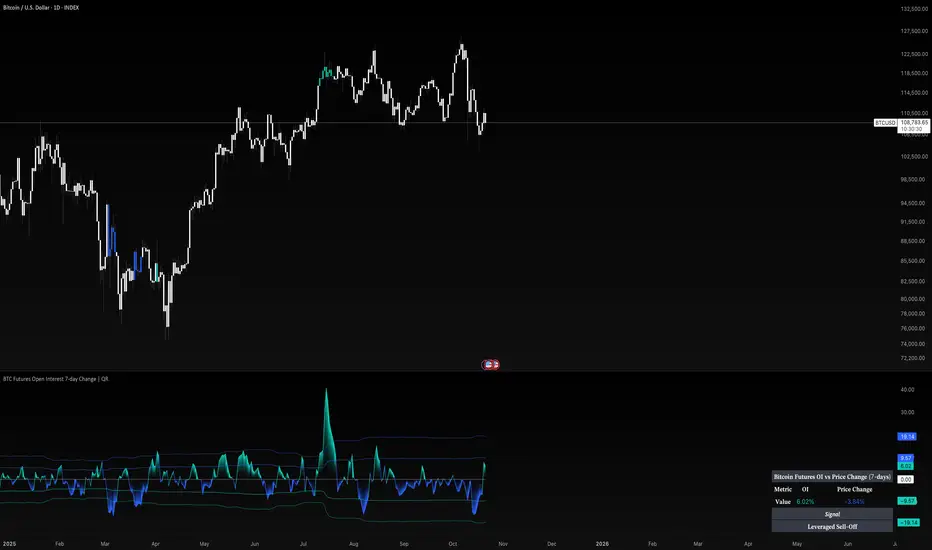
BTC Futures Open Interest 7-day Change | QRBitcoin Futures OI vs Price (7-Day)
What it is
This tool compares the 7-day momentum of Bitcoin perpetual futures Open Interest (OI) with the 7-day price change to classify market behavior into four intuitive regimes:
Leverage Rally (OI↑, Price↑) – positioning builds with rising price
Leveraged Sell-Off (OI↑, Price↓) – forced/short-term positioning into weakness
Deleveraging Sell-Off (OI↓, Price↓) – positions reduce while price falls
Spot Rally (OI↓, Price↑) – spot-led advance with lighter derivatives leverage
It is designed for BTC using the BINANCE:BTCUSD.P OI feed and a clean, self-contained visualization.
How it works (principle, not code)
OI Momentum: Calculates the 7-day Rate of Change (ROC) of BTC perpetual futures Open Interest.
Price Momentum: Calculates the 7-day ROC of the chart’s close.
Regime Logic: The sign of OI ROC and Price ROC determines the 4 regimes shown in the on-chart table label.
Volatility Context: A rolling standard deviation of OI ROC defines ±1σ and ±2σ bands. Bars are tinted when OI ROC exceeds ±2σ to highlight exceptional leverage shifts.
This is not a latency-sensitive microstructure model; it’s a context tool to see how derivatives positioning evolves relative to price.
Why it’s useful (originality & value)
Most OI overlays show a single line. This script adds:
a behavioral classifier (the 4 regimes) that’s immediately interpretable, and
adaptive σ-bands on OI momentum to distinguish routine leverage changes from abnormal expansions/flushes.
Together, they make it easier to read leverage cycles, spot rally quality, and identify riskier states (e.g., price up while OI surges vs. price up while OI fades).
What you see on the chart
Futures Open Interest (stepline) for BTC perpetuals (BINANCE:BTCUSD.P_OI).
OI ROC plot with zero line and ±1σ / ±2σ guides.
Bar tinting when OI ROC > +2σ (aggressive leverage build) or < −2σ (aggressive deleveraging).
Side table showing current OI ROC, Price ROC, and the regime label.
Note: If applied to a non-crypto symbol, OI will be suppressed and the script will warn that no OI data is available. It is intended for BTC.
Inputs & customization
Color mode: Choose among preset palettes to match your chart style.
(Other logic—lookbacks, σ-bands, and regime rules—are fixed to keep the reading consistent across users.)
How to use it
Confirm trends:
Leverage Rally with OI ROC above +1σ supports risk-on continuation.
Spot Rally can be constructive early in cycles, but be aware that OI can catch up quickly.
Caution in stress:
Leveraged Sell-Off often coincides with liquidation spikes and unstable conditions.
Deleveraging Sell-Off typically marks clearing phases; watch for stabilization as OI ROC returns toward 0.
Watch extremes:
±2σ moves in OI ROC are non-routine; combine with price structure, liquidations, and funding to refine decisions.
Use it as contextual confluence alongside your execution plan (levels, risk, and timeframe).
Chart-publishing guidance
Publish with a clean chart so the OI line, ROC bands, and regime label are easy to identify.
Avoid stacking unrelated indicators unless you explain why they are required to interpret the tool.
Limitations
OI feeds can vary by venue; this script uses Binance perpetual OI. Other venues may differ.
Short-term spikes (maintenance, outages, large block flows) can distort OI ROC for a few bars.
The σ-bands adapt to recent variability; regime persistence is more informative than a single spike.
Disclaimer
This script is for research and educational purposes only and is not financial advice. Trading involves risk, including loss of capital. Past performance does not predict or guarantee future results. Always validate on your timeframe and use robust risk management.
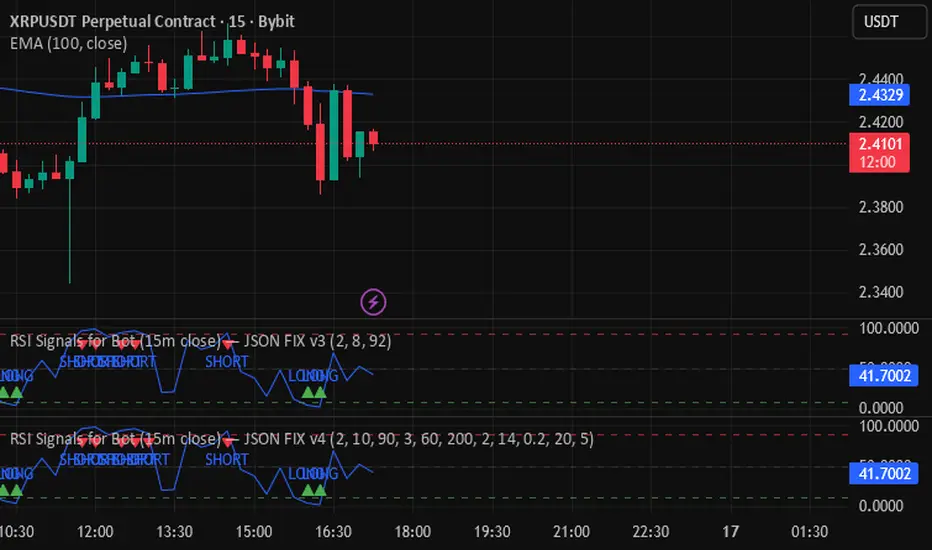
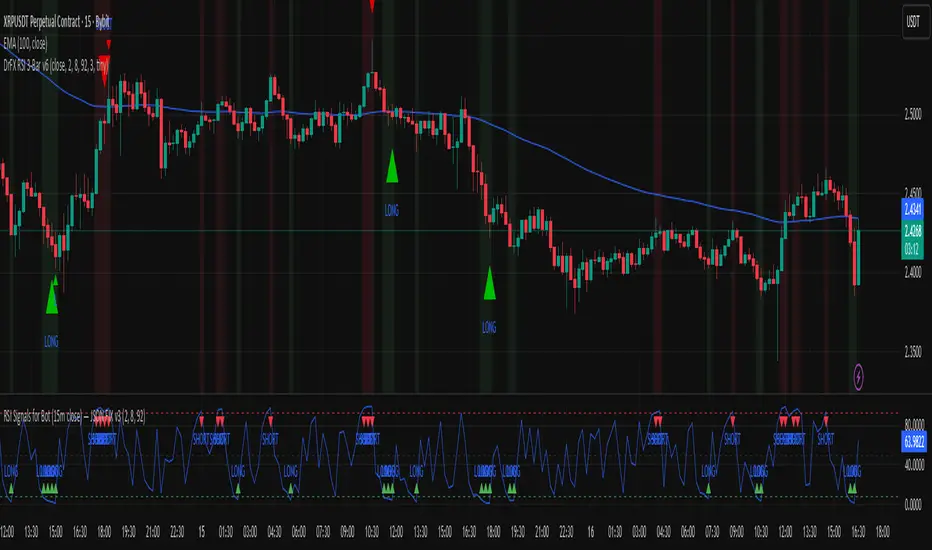
RSI Signals for Bot (15m close) — JSON FIX v4RSI Signals for Bot (JSON Ready) is a lightweight automation-friendly indicator that generates clean LONG and SHORT alerts based on RSI thresholds, fully formatted in JSON for webhook-based trading bots.
It’s designed primarily for 15-minute charts and sends one alert per confirmed bar close.
Rsi- bybitbot - JSON v3Backtesting based on the RSI indicator, based on the RSI length, RSI level, and the number of candles at the RSI level. Backtesting for monitoring in-points.
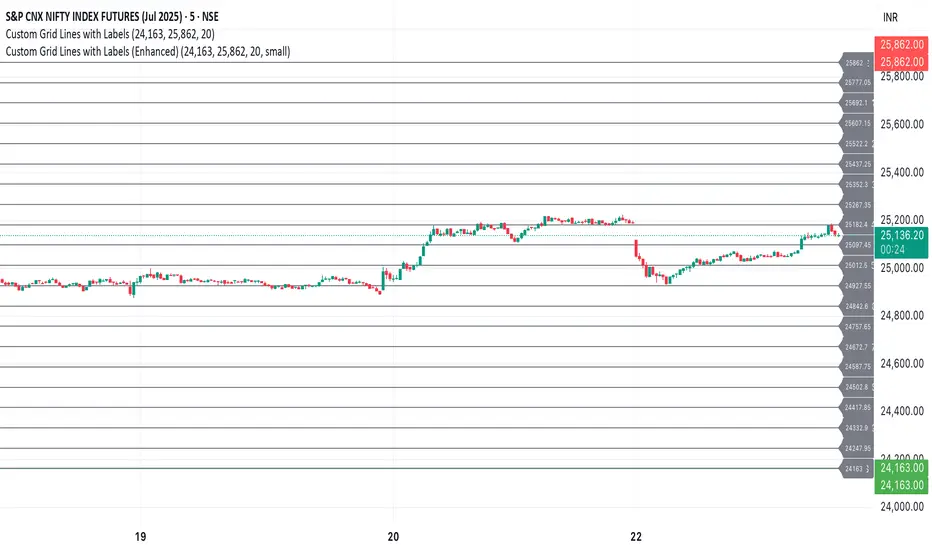
Custom Grid LinesThe Custom Grid Lines Indicator is a versatile tool designed for traders who want to manually define key price zones and visualize them with precision. This indicator allows users to select their own starting and ending price levels and automatically divides the range into user-defined grids using horizontal lines.
🔧 Key Features:
📍 User-Controlled Price Range:
Manually set the starting (bottom) and ending (top) price levels based on your trading plan, key zones, or market structure.
📊 Flexible Grid Setup:
Easily choose the number of grid lines to divide your selected range into equal price intervals.
📏 Automatic Grid Calculation:
The indicator calculates grid spacing and plots horizontal lines at each level, providing a clean and structured visual guide.
✅ Simple and Effective Visualization:
Ideal for grid trading, manual support/resistance plotting, or price zone tracking.
⚙️ How to Use:
Input the desired starting price (bottom of your range).
Input the ending price (top of your range).
Select the number of grids you want between these two levels.
The indicator will automatically draw all grid lines across your chart.
💡 Best For:
Grid Trading Strategies
Visualizing Custom Price Zones
Manual Support and Resistance Mapping
Session-Based Trading Ranges
Simple Pips GridOverview
This is a clean, simple, and highly practical indicator that draws horizontal grid lines at user-defined pip intervals.
Unlike other complex grid indicators, this script is designed to be lightweight and error-free. It eliminates automatic symbol detection and instead gives you full manual control, ensuring it works perfectly with any symbol you trade—FX, CFDs, Crypto, Stocks, Indices, and more.
Key Features
Universal Compatibility: Works with any trading pair by letting you manually define the pip value.
Fully Customizable: Easily set the pip interval for your grid (e.g., 10 pips, 50 pips, 100 pips).
Lightweight & Fast: Simple code ensures smooth performance without lagging your chart.
Visual Customization: Change the color, width, and style (solid, dashed, dotted) of the grid lines.
How to Use
It's incredibly simple to set up. You only need to configure two main settings:
Step 1: Set the "Pip Value"
This is the most important setting. You need to tell the indicator what "1 pip" means for the symbol you are currently viewing.
Go to the indicator settings and find the "Pip Value" input. Here are some common examples:
Symbol Pip Value (Input this number)
USD/JPY 0.01
EUR/USD 0.0001
GBP/USD 0.0001
XAU/USD (Gold) 0.1
JP225 (Nikkei 225) 10
US500 (S&P 500) 1
BTC/USD 0.1 or 1.0 (depending on your preference)
Step 2: Set the "Pip Interval"
Next, in the "Pip Interval" input, simply type how many pips you want between each line.
For a 10-pip grid, enter 10.
For a 50-pip grid, enter 50.
That's it! The grid will now be perfectly aligned to your specifications.
Additional Settings
Line Color, Width, Style: Customize the appearance of the lines to match your chart theme.
Number of Lines: Adjust how many lines are drawn above and below the current price to optimize performance and visibility.
This script was created with the assistance of Gemini (Google's AI) to be a simple and reliable tool for all traders. Feel free to use and modify it. Happy trading!

FSVZO | QuantumResearch🔊 FSVZO | QuantumResearch
Fourier Smoothed Volume Zone Oscillator
A proprietary hybrid oscillator blending momentum and frequency domain analysis
🧠 What Makes It Unique?
FSVZO introduces a novel approach to the classic Volume Zone Oscillator (VZO) by incorporating Discrete Fourier Transform (DFT) into both price and volume streams before calculating the VZO. This technique extracts the dominant frequency components from the market, resulting in a more stable and noise-filtered signal.
This hybrid approach of signal processing + volume-based trend detection sets it apart from traditional oscillators that only operate in the time domain.
⚙️ Core Concepts:
📈 Volume Zone Oscillator (VZO):
Built on a directional volume engine that emphasizes bullish/bearish pressure via smoothed volume flows.
🔍 Fourier Transform Layer:
A Discrete Fourier Transform is applied to the most recent price and volume arrays to isolate dominant cyclic components and suppress noise.
🧠 Trigger Line Comparison:
A smoothed EMA of the oscillator is used as a signal line for crossovers, highlighting momentum shifts.
🔍 Key Features:
✅ Fourier-Decomposed Source Data
✅ Adaptive Smoothing of the Signal Line
✅ Color-coded Trend Conditions
✅ Customizable Thresholds for Overbought/Oversold Regions
✅ Background Fill Zones for Visual Context
✅ Bar Color Overlays to Track Signal Transitions
📌 How to Use It:
When FSVZO > Trigger Line, bullish volume momentum dominates (green bars).
When FSVZO < Trigger Line, bearish volume momentum dominates (red bars).
Use ±60/90 zones as overbought and oversold thresholds.
Great for momentum confirmation, mean-reversion plays, and early trend detection when used with price action or moving averages.
⚠️ Designed For:
Momentum traders looking for a volume-aware oscillator
Analysts seeking signal stability through frequency filtering
Traders wanting a modern, noise-reduced alternative to RSI/MFI/VZO
⚠️ Disclaimer:
This script is for educational and research purposes only.
Past performance does not guarantee future results.
Always confirm with other indicators, price structure, and risk management.
