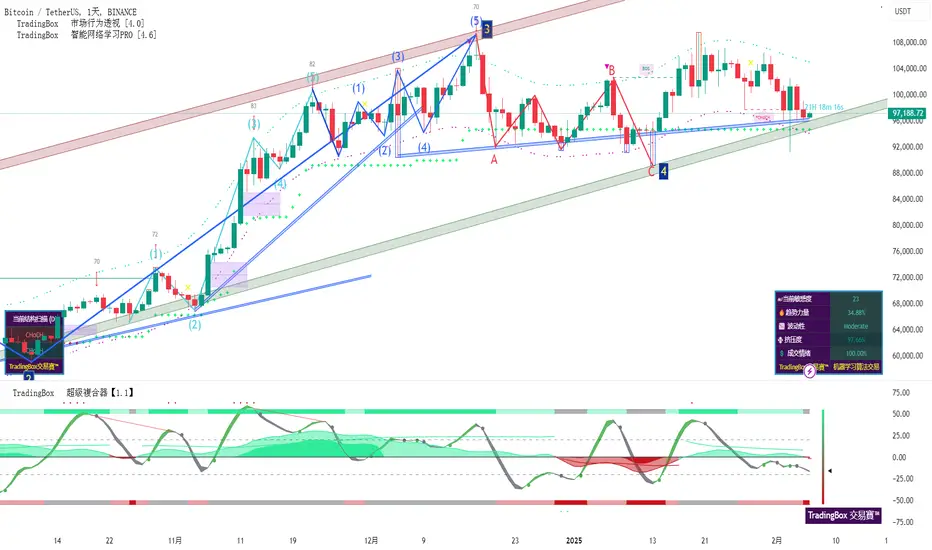
耐心等待!今日加密货币恐慌与贪婪指数降至 49(昨日为 54),等级仍为中性。 据巴伦周刊:美国联邦存款保险公司(FDIC)计划修改银行指导方针,允许银行在无需事先获得监管批准的情况下开展某些加密业务。 “这意味着银行可以托管客户的加密货币,并且将由 FDIC 进行保险,在推动美银行与加密货币的关联方面具有积极意义”。 日本央行“鹰王”田村直树:必须将利率提升至名义上被视为中性的水平,至少需要达到1%左右。 “目前日本的基准利率为0.5%,他的观点是在4月份后的下一个财年至少加息两次25基点甚至更多,小日本常年保持负利率,由于套利资金等的存在,其提高利率的预期会对全球金融市场造成较大的影响,去年805暴跌的惨案多半归咎于它。” 欧洲央行管委:支持逐步降息25个基点,面对潜在关税,欧洲必须齐心协力,并预见即将进行的谈判。 美联储巴尔金:美联储巴尔金:今年仍倾向于降息,未看到经济过热迹象。 香港立法会议员吴杰庄:香港需加快研究将比特币纳入战略储备的可行性。 …… 技术面昨天给出的图表很明确了,基本都是按着画的线走的,围绕中枢震荡还要很多天,属于短线选手的自留地,趋势选手就不要凑热闹了。 今早8点收线后日线级别“CharlesK7 Trend”指标转为中性趋势,对于空仓的趋势选手未来会有很好的进场信号可以参考,以最小的止损博最大的收益,乃趋势交易之精髓。 山寨币占有率最近有了“CharlesK7 买点”周线级别预警,本周收线后才能确认是否有效,如果得到确认,山寨币也许未来可期。 对了,最近BitMex联合创始人Arthur Hayes关于美国比特币战略储备的文章挺有意思,太长了就不贴了大家自己去找吧。 就酱。 20250206 by CharlesK7由BitK77提供6
301013 利和兴:新能源车全系产业正在蠢蠢欲动The entire new energy vehicle industry is on the move 行业:机械设备>专用设备>其他专用设备 概念:医疗器械概念、5G、工业4.0、富士康概念、元器件、华为汽车、柔性屏、无线耳机、OLED、高端装备、消费电子概念、华为概念、智能制造、陶瓷电容、机器视觉、新型工业化、充电桩、华为昇腾 华为称2024年底部署全液冷超充超10万个;特斯拉宣布充电网络开放升级 OLED+充电桩+华为 公司与华为主要在移动智能终端、通讯基站等多个领域进行合作,此外为充电桩提供测试设备 充电桩 公司主业为定制测试类(主供华为及荣耀3C类和车载OBC产品)及生产组装类智能装备(屏厂),后将拓展储能侧逆变器测试装备及充电桩代工业务 Industry: Mechanical Equipment > Special Equipment > Other Special Equipment Concepts: Medical Equipment Concept, 5G, Industry 4.0, Foxconn Concept, Components, Huawei Automobile, Flexible Screen, Wireless Headphones, OLED, High-end Equipment, Consumer Electronics Concept, Huawei Concept, Intelligent Manufacturing, Ceramic Capacitor, Machine Vision, New Industrialization, Charging Pile, Huawei Ascend Huawei said that it will deploy more than 100,000 full liquid-cooled superchargers by the end of 2024; Tesla announced the opening and upgrading of the charging network OLED+Charging Pile+Huawei The company and Huawei mainly cooperate in multiple fields such as mobile smart terminals and communication base stations. In addition, it provides testing equipment for charging piles Charging Pile The company's main business is customized testing (mainly supplying Huawei and Honor 3C and vehicle-mounted OBC products) and production and assembly of intelligent equipment (screen factory), and will expand the energy storage side inverter testing equipment and charging pile OEM business later做多由AASFANS提供2
原油周低点完成之前应持续2-3周熊市原油应该有 2-3 周左右的时间里横盘整理,理想下行空间应限制在12⽉低点以上。且下⼀个熊市反转日周重合看跌不太可能在下周前出现。大家是怎么看的呢? 由AIstarry提供4
黄金周级别趋势分析日线已经连续两周超买,警惕日线高点将出现,面临横盘修正行情。黄金从 12 月低点冲动式的上涨,这强烈表明主要趋势已经反转为牛市,虽然日线级别小5浪即将完成,可能面临修正,但整体牛市趋势应该持续数周甚至数月的时间。 由AIstarry提供3
BTC周级别趋势分析在创下周高点之前,行情至少应该持续2-3周的牛市。过去几天的横盘下跌趋势应该是修正的⼀部分,且该修正应该很快就能结束,开启上涨并创下新高。大家是怎么认为的呢? 由AIstarry提供3
标普500未来3-4天可能会出现日线低点吗?当前ES已经进行了牛市反转,但任何下跌都应该是牛市趋势的修正,牛市应该持续 2-3 周左右。且目前超波下行,未来3-4天可能会出现日线低点。 由chengzio提供1
BTC当前处于修正位置吗?比特币当前应该处在完成第 4 浪修正的位置, 并且开启第5浪直至2月下旬后。该修正应该很快就能结束,开启上涨并创下新高。在创下周高点之前,行情至少应该持续2-3周的牛市。 由chengzio提供1
高悬的达摩克利斯之剑:解构大市值资产的结构性困境 The Sword of Damocles Hanging High高悬的达摩克利斯之剑:解构大市值资产的结构性困境 在资本市场剧烈分化的2023年,沪深300与上证50指数持续跑输中证1000等中小盘指数,这一现象绝非偶然的市场波动。当我们穿透表象审视深层逻辑,会发现大市值资产正面临前所未有的结构性压力。这不是简单的估值回归,而是中国资本市场生态演进的必然结果。 一、宏观叙事逻辑的根本性转变 后疫情时代的经济复苏呈现出鲜明的K型分化特征。传统经济引擎的动能衰减与新兴产业崛起的错位共振,正在重塑资本市场的价值坐标系。2023年二季度规模以上工业企业利润同比下降12.4%,但同期高技术制造业投资增速高达11.8%,这种冰火两重天的分化直接映射到资本市场。当传统蓝筹股的盈利增速难以匹配其估值水平时,资金必然选择用脚投票。 货币政策传导机制的梗阻加剧了这种分化。尽管市场流动性保持充裕,但信用扩张更多流向政策扶持的专精特新领域。央行定向工具的使用使得传统大盘股难以享受流动性外溢效应,反而在存量博弈中成为资金抽水的重灾区。 二、估值体系的重构与定价权的转移 当前沪深300指数动态市盈率仍处于近十年65%分位,而上证50股息率与十年期国债收益率的利差持续收窄至历史低位。这种估值溢价在注册制全面实施背景下显得愈发脆弱,随着新股供应常态化,市场正在用更苛刻的标准重新评估大市值公司的成长溢价。 机构投资者结构的演变正在悄然改变游戏规则。截至2023年6月,私募证券基金管理规模首破6万亿,其灵活的操作风格与公募基金的"抱团"策略形成鲜明对比。当市场定价权从"头部集中"转向"多点开花",大市值股票流动性溢价必然遭受冲击。 三、产业周期与资本周期的共振压力 传统行业面临的双重去杠杆压力不容小觑。资产负债表端的债务出清与利润表端的毛利率挤压形成戴维斯双杀,这在房地产产业链相关权重股中表现得尤为明显。当ROE中位数跌破资本成本时,价值陷阱的幽灵开始显现。 技术创新带来的颠覆性力量正在改写行业规则。新能源对传统能源的替代、AI对金融服务的重构、国产替代对核心技术的突破,这些变革使得传统行业龙头的护城河面临坍塌风险。资本市场的定价逻辑正在从"规模溢价"转向"创新溢价"。 站在当下时点,投资者需要清醒认识到:资本市场正在经历从"大而美"到"专而精"的范式转换。这种转变既源于经济结构的深层调整,也受制于资本属性的本质嬗变。当产业变革的洪流与资本定价的重构形成共振,大市值资产或将面临持续的价值重估压力。这不是短期的市场波动,而是时代浪潮下的必然选择。 对于A股市场上证50与沪深300系列的大屁股不容乐观 The sword of Damocles hanging high: Deconstructing the structural dilemma of large-cap assets In 2023, when the capital market is sharply divided, the CSI 300 and SSE 50 indices continue to underperform small and medium-cap indices such as the CSI 1000. This phenomenon is by no means an accidental market fluctuation. When we look through the surface and examine the deep logic, we will find that large-cap assets are facing unprecedented structural pressure. This is not a simple valuation regression, but an inevitable result of the ecological evolution of China's capital market. 1. Fundamental transformation of macro narrative logic The economic recovery in the post-epidemic era presents a distinct K-shaped differentiation feature. The dislocated resonance of the decline in the momentum of the traditional economic engine and the rise of emerging industries is reshaping the value coordinate system of the capital market. In the second quarter of 2023, the profits of industrial enterprises above designated size fell by 12.4% year-on-year, but the growth rate of high-tech manufacturing investment in the same period was as high as 11.8%. This kind of ice and fire differentiation is directly reflected in the capital market. When the profit growth rate of traditional blue-chip stocks is difficult to match their valuation level, funds will inevitably choose to vote with their feet. The obstruction of the monetary policy transmission mechanism has exacerbated this differentiation. Although market liquidity remains abundant, credit expansion flows more to specialized and new areas supported by policies. The use of targeted tools by the central bank makes it difficult for traditional large-cap stocks to enjoy the liquidity spillover effect. Instead, they have become the hardest hit area for capital withdrawal in the stock game. 2. Reconstruction of the valuation system and transfer of pricing power The current dynamic price-earnings ratio of the CSI 300 Index is still at the 65% percentile in the past decade, while the spread between the dividend yield of the Shanghai Stock Exchange 50 and the yield of the ten-year treasury bond continues to narrow to a historical low. This valuation premium has become increasingly fragile under the background of the full implementation of the registration system. As the supply of new shares becomes normalized, the market is re-evaluating the growth premium of large-cap companies with more stringent standards. The evolution of the structure of institutional investors is quietly changing the rules of the game. As of June 2023, the management scale of private equity funds exceeded 6 trillion yuan for the first time, and its flexible operating style is in sharp contrast to the "grouping" strategy of public funds. When the market pricing power shifts from "head concentration" to "multi-point blossoming", the liquidity premium of large-cap stocks will inevitably suffer a shock. 3. Resonance pressure of industrial cycle and capital cycle The double deleveraging pressure faced by traditional industries should not be underestimated. The debt clearance on the balance sheet and the squeeze on gross profit margin on the income statement form a Davis double kill, which is particularly evident in the weight stocks related to the real estate industry chain. When the median ROE falls below the cost of capital, the ghost of the value trap begins to appear. The disruptive power brought by technological innovation is rewriting the rules of the industry. The replacement of traditional energy by new energy, the reconstruction of financial services by AI, and the breakthrough of core technology by domestic substitution, these changes have put the moat of traditional industry leaders at risk of collapse. The pricing logic of the capital market is shifting from "scale premium" to "innovation premium". At the current point in time, investors need to be aware that the capital market is undergoing a paradigm shift from "big and beautiful" to "specialized and refined". This transformation stems from both the deep adjustment of the economic structure and the essential transformation of capital attributes. When the torrent of industrial change resonates with the reconstruction of capital pricing, large-cap assets may face continuous pressure to revalue. This is not a short-term market fluctuation, but an inevitable choice under the tide of the times.做空由AASFANS提供110
吃瓜!一个只吃不吐的比特币超级巨鲸微策略MicroStrategy自被纳入纳斯达克100后,结束了连续12周的购买,市场猜测是受到相关规则和法规的约束和面对未实现比特币收益的190亿巨额税单,必须进行财务规划以规避税务。 看了下最新数据,截止目前MicroStrategy已持有471,107枚比特币,总购买成本约为304亿美元,总持仓价值约为462亿美元,平均购买价格约为64511美元,对比华尔街寡头贝莱德的577亿的总持仓价值毫不逊色。 微策略这种通过股票增发与股权融资,债务融资与可转换债券等左脚踩右脚的方式已连续购买多年,尽管其长期筹资计划表明未来可能继续增持,但比特币价格如果面临深度下跌,被迫卖币还债也不会是什么新鲜事了。 白宫加密主管David Sacks在美国数字资产领域的领导计划会议中表示,比特币战略储备正在推进,但无法就「主权财富基金是否持有加密」做出任何回答,短期另市场失望,但会议规格较高且承诺加密领域清晰度立法,长期看是个好事,有向我东大发布会模仿的样子。 美联储理事杰斐逊:不必急于进一步降息,强劲的经济使得谨慎应对变得适当。 为应对反制中国多部委对美国商品和美国企业采取加税、立案调查等措施,贸易战就是个自损八百伤敌一千的事儿,向来对风险资产是个打击,黄金已连续破新高。 今天最有意思的瓜莫过于孙宇晨和李林之间的撕逼了,孙割说在收购火币时,李林隐瞒尽调材料,在内部搞了一个3000万美元的窟窿最后动手脚发现,揭穿之后耍赖皮一分不给,自己填上了。李林今天回复说,已做财务弥补,不存在所谓的「资金窟窿」。 实际这3000万美金就是所谓用户欠交易所的钱,交易所没有及时强平,导致用户“穿仓”,交易所要不回来了,只能算坏账。这部分坏帐孙割方面没说具体细节,刚又强调3000万美金就是没给,有待下一步继续撕,揭开割韭菜内幕😂 …… 技术面10.2k附近冲高回落后,暂时止跌于96k附近,前几日多次提到,这里大概率最低要走一个4h级别笔中枢甚至1D级别笔中枢才有突破可能,如图为4h级别所示:短线围绕中枢区间的支撑压力来回折腾就行了,对于只做趋势的选手这里是垃圾时间,耐心等待最后一笔的形成。(个人倾向于绿色走势类型 今早8点收线后日线级别“CharlesK7 Trend”指标依然为看涨趋势。还是那句话:“短线投机尚可,格局大大的不要”。 20250205 by CharlesK7由BitK77提供225
两极反转!昨晚美股开盘后迎来了两个好消息:1、美墨、美加同意暂缓一个月实施加征关税措施,2、白宫加密货币主管即将就美国政府在数字资产领域的领导计划召开新闻发布会。 由贸易战引发的滞胀担忧市场暂时缓解,预计此类政策的影响将反反复复,直至市场完全消化,美国比特币战略储备进展速度虽未及市场预期,但总归在推进中。 特朗普指示财政部和商务部在90天内提交美国新主权财富基金计划,其中包括关于「融资机制、投资策略、基金结构和治理模式」的建议,是否涉及比特币相关暂时未知。 美国1月ISM制造业指数自2022年10月以来首次进入扩张区间,1月标普全球制造业PMI终值录得51.2,为7个月以来首次回升至50.0以上。 古尔斯比:美联储在降息方面需要更加小心谨慎;博斯蒂克:准备在一段时间内保持等待,然后再进行降息;再次降息的前提是希望看到住房通胀开始放缓,预计不会在3月FOMC货币政策会议之前掌握与关税问题相关的通胀信息。 近期不管是鲍威尔还是各地区主席的讲话都相对鹰派,为3月维持当前利率进行预期管理的同时并为5-6月开始降息留出空间,截止目前3月不降息的概率为86.5%,6月不降息的概率为39.2%。充分与市场沟通的好处就是不至于政策落地时市场一惊一乍,Price in的程度才是市场的走势。 ... 技术面昨日BTC超跌反弹了12.35%,收下一根放量下影线,并于ICT 1D和4h FVG共振点10.2k附近受阻,走势相对乐观并于去年805较为相像,预计91k附近做底的概率较大,回踩几个4h FVG且走出4h或日线级别笔中枢就是标准的突破走势。 今早8收线后日线级别“CharlesK7 Trend”指标依然为看涨趋势。 2月的走势类型需要时间去充分消化,对主做趋势的选手并不友好,近日依然是昨日讲过的 “短线投机尚可,格局大大的不要”。 20250204 by CharlesK7 由BitK77提供3
贸易战,由币圈买单!前有DeepSeek空袭华尔街,后有川普对多国实施加征关税,受此些消息影响,比特币在春节先后最大跌幅16.75%,节日红包没收到,迎来了70多万人爆仓的尸横遍野。 ... 技术面1月27日周线级别出现“CharlesK7 卖点”预警,2月3日卖点信号确认。 4小时级别趋势指标“CharlesK7 Trend”在2月1日16时跌破10.22k已转为看跌趋势, 日线级别截止目前依然为看涨趋势(需明日早8确认)。 跌破1月27日97.777k低点,日线级别已出现缠论二卖,向下线段已成立。 … 今日 BINANCE:BTCUSDT 在ICT 1D OB与4h FVG共振支撑处附近暂时止跌,综上预计近些时日宽幅震荡概率较大,短线投机尚可格局大大的不要。 2025年2月3日 by CharlesK7 由BitK77提供444
300509 新美星:机器人穿越一个世纪的主线行业:机械设备>专用设备>印刷包装机械 概念:工业4.0、食品包装、机器视觉、机器人概念 机器人+专用设备 公司主营液态食品包装机械的制造,包括流体系列设备、灌装系列设备、二次包装系列设备以及全自动高速PET瓶吹瓶设备四大品类 公司现有产品、技术等方面涉及成品机器人,具体如下:1、公司二次包装系列设备产品中包含分拣机器人、机器人装箱机、机器人码垛机等机器人产品,我们在高速码垛机上集成了采用伺服驱动的机械手装置; 2、公司现有视觉、伺服驱动等技术可以应用于机器人领域。 Industry: Mechanical Equipment > Special Equipment > Printing and Packaging Machinery Concept: Industry 4.0, Food Packaging, Machine Vision, Robot Concept Robot + Special Equipment The company is mainly engaged in the manufacture of liquid food packaging machinery, including four categories: fluid series equipment, filling series equipment, secondary packaging series equipment and fully automatic high-speed PET bottle blowing equipment The company's existing products and technologies involve finished robots, as follows: 1. The company's secondary packaging series equipment products include sorting robots, robot packers, robot palletizers and other robot products. We have integrated servo-driven manipulators on high-speed palletizers; 2. The company's existing vision, servo drive and other technologies can be applied to the field of robots.做多由AASFANS提供3
603336 宏辉果蔬 :坐等暴涨 603336 Waiting for a surge in prices行业:农林牧渔>农产品加工>果蔬加工 概念:贸易战受益股、苹果期货、乡村振兴、冷链物流、农业种植、新零售、社区团购、电子商务 我国确定2025年粮食生产三大重点任务 果蔬产品+马来西亚榴莲+农业种植 唯一大型水果供应商上市公司,主营为苹果、葡萄等水果生产 1.公司是一家集果蔬产品的种植管理、采后收购、产地预冷、冷冻仓储、预选分级、加工包装、冷链配送于一体的专业生鲜产品服务商。2.公司速冻食品业务主要为速冻食品研发生产加工销售,于2021年9月投产并推出“丰收哥”系列速冻食品,包含速冻包点,速冻汤圆,速冻饺子,米糕等多品类产品。 Industry: Agriculture, forestry, animal husbandry and fishery > agricultural product processing > fruit and vegetable processing Concept: Trade war beneficiary stocks, apple futures, rural revitalization, cold chain logistics, agricultural planting, new retail, community group buying, e-commerce my country has determined three key tasks for grain production in 2025 Fruit and vegetable products + Malaysian durian + agricultural planting The only large-scale fruit supplier listed company, mainly engaged in the production of apples, grapes and other fruits 1. The company is a professional fresh product service provider integrating planting management, post-harvest acquisition, pre-cooling at the origin, frozen warehousing, pre-selection and grading, processing and packaging, and cold chain distribution of fruit and vegetable products. 2. The company's quick-frozen food business is mainly for the research and development, production, processing and sales of quick-frozen food. It was put into production in September 2021 and launched the "Brother Fengshou" series of quick-frozen foods, including quick-frozen buns, quick-frozen glutinous rice balls, quick-frozen dumplings, rice cakes and other categories of products.做多由AASFANS提供1
继续看多无人驾驶:603037 凯众股份行业:交运设备>汽车零部件>汽车零部件Ⅲ 概念:新能源汽车、理想汽车概念、比亚迪概念、无人驾驶、小米概念、长安汽车概念、小米汽车、高股息精选 中央空管委即将在六个城市开展eVTOL试点 小米汽车+华为汽车+聚氨酯材料+汽车零部件 1、公司主要生产乘用车底盘悬架系统减震元件和操控系统踏板总成产品,其中减震元件中的缓冲块国内市占率第二,通过了小米汽车的缓冲块新供应商准入审核; 2、公司是华为汽车主要合作伙伴赛力斯、江淮、和奇瑞的核心供应商,为赛力斯供货全系的聚氨酯缓冲块产品,为江淮和奇瑞供货大部分聚氨酯缓冲块和轻量化踏板产品; 3、公司减振产品和制动产品可开发并用于飞行汽车 1.2023年4月26日公司在互动平台表示,智能驾驶ADAS软件已经成功应用,在保证车规级安全的前提下,把握未来技术发展趋势,对用户使用新场景、跨域协同及数据闭环有非常深入的研究和技术储备。2.飞行汽车也需要悬架系统和制动系统,公司减振产品和制动产品可开发并用于飞行汽车。做多由AASFANS提供1